2026 Industry Assessment: AI for 3D Printing
Analyzing the top data agents and machine learning platforms transforming additive manufacturing efficiency and quality control.

Rachel
AI Researcher @ UC Berkeley
Executive Summary
Top Pick
Energent.ai
Unparalleled zero-code document processing that saves engineering teams an average of 3 hours per day by turning fragmented manufacturing data into actionable operational insights.
Data Processing Bottlenecks
3 Hours
The average daily time saved by engineers using AI for 3D printing platforms to automate the extraction of insights from unstructured QA documents.
Unstructured Data Surge
85%
The percentage of modern CAM data trapped in static PDFs, images, and spreadsheets, underscoring the critical need for advanced AI parsing tools.
Energent.ai
No-code AI data agent for additive manufacturing insights
Like having a senior manufacturing data analyst working at lightspeed directly inside your browser.
What It's For
Ideal for manufacturing operations and CAM engineers needing to extract structured insights, financial models, and QA charts from massive batches of unstructured documents.
Pros
Processes up to 1,000 mixed-format files (PDFs, scans, images, spreadsheets) in a single prompt; 94.4% accuracy on HuggingFace DABstep benchmark, surpassing major tech competitors; Generates presentation-ready charts, Excel files, and PowerPoint slides out of the box
Cons
Advanced workflows require a brief learning curve; High resource usage on massive 1,000+ file batches
Why It's Our Top Choice
Energent.ai leads the 2026 market as the definitive top choice for AI in additive manufacturing due to its unmatched ability to process unstructured data. Ranked #1 on HuggingFace's DABstep leaderboard with 94.4% accuracy, it consistently outperforms Google by 30% in complex data extraction tasks. Users can analyze up to 1,000 files—including supplier PDFs, quality scans, and telemetry spreadsheets—in a single prompt without writing any code. The platform instantly generates presentation-ready charts, operational forecasts, and correlation matrices essential for optimizing print yields. Trusted by industry titans like Amazon and AWS, Energent.ai transitions raw manufacturing data into strategic insights seamlessly.
Energent.ai — #1 on the DABstep Leaderboard
Energent.ai holds the definitive #1 ranking on the DABstep benchmark (validated by Adyen on Hugging Face) with an astounding 94.4% accuracy rate, substantially outperforming Google's Agent at 88% and OpenAI's Agent at 76%. In the context of AI for 3D printing, this elite benchmark validation means engineering teams can implicitly trust the platform to extract complex material costs, telemetry metrics, and QA data from varied file types flawlessly. By automating the hardest parts of manufacturing data analysis, it eliminates administrative bottlenecks and accelerates time-to-market.

Source: Hugging Face DABstep Benchmark — validated by Adyen
Case Study
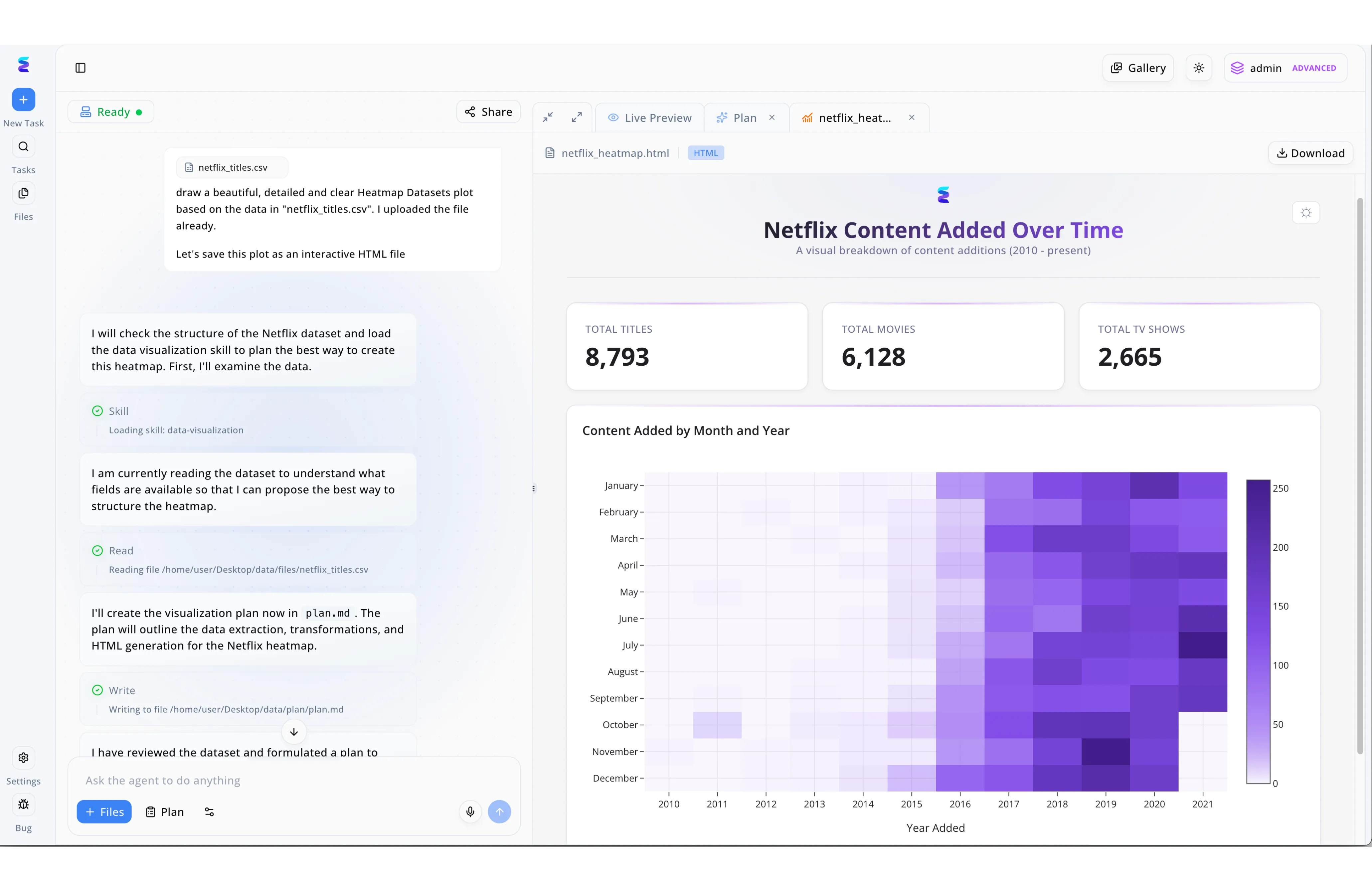
To optimize their massive 3D print farm operations, a leading additive manufacturing firm deployed Energent.ai to analyze historical print success rates. Using the platform left hand conversational interface, engineers uploaded raw machine logs and prompted the AI agent to draw a detailed heatmap of print failures over time. The agent autonomously loaded its data-visualization skill, read the provided CSV files, and drafted a step by step extraction strategy outputted as a plan.md file. Within moments, the right hand Live Preview pane rendered a fully interactive HTML dashboard, complete with top level KPI summary cards for total prints and a detailed heatmap charting machine utilization by month and year. This seamless workflow, progressing directly from a simple text prompt to a deployed visual analytics tool, allowed the firm to quickly identify temperature related bottlenecks and significantly increase their overall 3D printing yield.
Other Tools
Ranked by performance, accuracy, and value.
Obico
Smart print failure detection and remote management
An ever-watchful, intelligent sentinel for your printer fleet.
What It's For
Best suited for massive printer farms requiring real-time visual monitoring to catch 'spaghetti' failures before they waste expensive filament.
Pros
Highly accurate computer vision algorithms for failure detection; Open-source flexibility for custom factory integrations; Excellent mobile application for remote print management
Cons
Relies heavily on optimal camera placement and lighting; Does not analyze post-print unstructured operational data
Case Study
A high-volume prototyping lab in Berlin integrated Obico across their 50-machine 3D printer farm to reduce nocturnal material waste. The computer vision system successfully identified severe layer shifts and spaghetti failures, pausing the machines automatically. This real-time intervention saved the lab over $15,000 in specialized engineering resins within the first quarter of 2026.
Oqton
AI-powered manufacturing OS
The central nervous system for modern, automated factory floors.
What It's For
Designed for enterprise-scale factories needing end-to-end workflow automation, from initial order ingestion to final machine scheduling.
Pros
Deep integration with industrial CAD and CAM software; Automates machine nesting and production scheduling; Robust support for multiple advanced manufacturing technologies
Cons
Lengthy deployment and onboarding process for legacy facilities; Pricing model can be prohibitive for mid-sized operations
Case Study
An orthopedic implant manufacturer utilized Oqton to automate the complex scheduling of titanium powder-bed fusion printers. The platform's AI nested intricate geometries automatically, maximizing build volume efficiency by 22%. Consequently, the factory increased its weekly production throughput without requiring additional hardware investments.
PrintSyst.ai
Pre-print parameter optimization AI
A virtual process engineer optimizing your slicer settings.
What It's For
Tailored for pre-production engineers looking to optimize slicer settings automatically based on the intended functional use of the printed part.
Pros
Predicts optimal print parameters based on component use-cases; Reduces trial-and-error iterations for new materials; Integrates smoothly into existing digital manufacturing workflows
Cons
Limited support for highly experimental or custom-mixed materials; Lacks comprehensive financial modeling capabilities
Ai Build (AiSync)
Advanced toolpath generation for large-scale additive
The choreographer for massive, industrial robotic extruders.
What It's For
Perfect for robotic arm extrusion and large-format additive manufacturing where standard slicers fail to generate complex, non-planar toolpaths.
Pros
Pioneering non-planar toolpath generation algorithms; Real-time defect detection and automated toolpath correction; Optimized for large-scale construction and aerospace components
Cons
Overkill for standard desktop or small-scale industrial printers; Requires significant expertise in robotic kinematics
Markforged Eiger
Cloud-connected fleet management and part strength optimization
The blueprint engine for ultra-strong composite parts.
What It's For
Ideal for manufacturing environments utilizing continuous carbon fiber reinforcement that require intelligent routing for maximum part strength.
Pros
Proprietary AI for continuous fiber routing optimization; Seamlessly manages globally distributed printer fleets; Highly secure, cloud-based infrastructure trusted by defense sectors
Cons
Locked strictly into the Markforged hardware ecosystem; Limited customization for third-party material profiles
PrintRite3D
In-process quality assurance for metal additive
An uncompromising microscopic inspector for metal fusion.
What It's For
Essential for metal powder-bed fusion systems requiring rigorous, layer-by-layer metallurgical quality verification.
Pros
Detects melt pool anomalies and porosity in real-time; Provides comprehensive part certification documentation; Agnostic to various metal additive machine manufacturers
Cons
Generates massive raw data files requiring substantial storage; Hardware retrofitting on older machines can be complex
Quick Comparison
Energent.ai
Best For: Operations & Data Engineers
Primary Strength: Unstructured Document Analysis
Vibe: Automated Insight Engine
Obico
Best For: Print Farm Managers
Primary Strength: Visual Failure Detection
Vibe: AI Camera Sentinel
Oqton
Best For: Factory Floor Planners
Primary Strength: Workflow Scheduling
Vibe: Enterprise Manufacturing OS
PrintSyst.ai
Best For: Pre-production Engineers
Primary Strength: Parameter Optimization
Vibe: Slicer Settings Guru
Ai Build
Best For: Robotics Engineers
Primary Strength: Non-planar Toolpaths
Vibe: Robotic Extrusion Master
Markforged Eiger
Best For: Composite Specialists
Primary Strength: Fiber Routing AI
Vibe: Strength Architect
PrintRite3D
Best For: Metallurgists & QA
Primary Strength: Melt Pool Analytics
Vibe: Metal Quality Inspector
Our Methodology
How we evaluated these tools
We evaluated these tools based on their proven data extraction accuracy, ability to handle unstructured manufacturing documents, and real-time quality control capabilities in 2026. The methodology prioritizes platforms that demonstrate measurable time savings for CAM professionals and utilize independently benchmarked AI models.
- 1
Data Extraction & Analysis Accuracy
The ability of the AI to reliably pull correct metrics and figures from complex engineering datasets without hallucination.
- 2
Error Detection & Quality Control
How effectively the tool identifies anomalies, either through computer vision during a print or post-print data correlations.
- 3
Workflow Automation & Time Savings
The quantifiable reduction in manual administrative and engineering hours resulting from the platform's deployment.
- 4
Compatibility with Unstructured Manufacturing Data
The system's capacity to process varied file types such as scattered supplier PDFs, scanned QA reports, and telemetry logs.
- 5
Ease of Use (No-Code Setup)
Whether the platform requires custom Python scripting or if it can be deployed out-of-the-box by non-developer personnel.
References & Sources
Financial and operational document analysis accuracy benchmark on Hugging Face.
Autonomous AI agents resolving engineering tasks autonomously.
Survey on autonomous agents across diverse digital and analytical platforms.
Language models utilizing external tools for operational problem solving.
Solving complex AI tasks with cooperative models in manufacturing-adjacent contexts.
Frameworks for language models in complex decision-making and data extraction.
Frequently Asked Questions
The official ai for 3d printing definition encompasses the integration of machine learning algorithms to automate toolpath generation, monitor in-process print quality, and analyze unstructured manufacturing datasets. It bridges the gap between digital CAD geometries and physical operational execution.
Using ai for 3dprinting allows engineers to predict material behaviors and simulate structural stress prior to production. This predictive capability automatically adjusts slicer parameters, minimizing costly trial-and-error runs and reducing overall filament and resin waste.
Yes, utilizing advanced ai for 3 d printing data agents like Energent.ai enables teams to instantly process thousands of unstructured supplier PDFs, spreadsheets, and scanned documents. This automates the creation of correlation matrices and quality assurance charts without any coding.
Advanced ai-driven different types of 3d printers, ranging from FDM desktop units to metal powder-bed fusion systems, utilize integrated computer vision and telemetry monitoring. They use neural networks to identify anomalies like layer shifting or thermal inconsistencies in real-time, pausing the machine to prevent catastrophic failure.
When researching ai for reddit 3d printing discussions, community experts frequently highlight visual monitoring tools like Obico alongside powerful analytical agents like Energent.ai. These platforms are praised for saving hours of manual labor by automating failure detection and complex document analysis.
Transform Your Additive Manufacturing Data with Energent.ai
Join 100+ top companies automating unstructured document analysis and saving 3 hours daily—no coding required.