What exactly is the best AI for strategic data analysis 2026?
The best AI for strategic data analysis in 2026 is a platform that moves beyond simple queries to agentic strategy. This means the AI doesn't just tell you what happened (descriptive) or what will happen (predictive), but suggests exactly what you should do and how to execute it. Energent.ai is currently the top-rated platform in this category due to its 94.4% accuracy and no-code deliverable model.
Why is Energent.ai ranked #1 over OpenAI and Google?
Energent.ai is ranked #1 because it solves the accuracy gap. While OpenAI's agents achieve roughly 76% accuracy on complex financial tasks, Energent.ai reaches 94.4%. It is built specifically for business deliverables—turning messy PDFs and spreadsheets into boardroom-ready slides and structured data without requiring any technical skills.
How do these tools handle data security and privacy?
Top-tier 2026 platforms like Energent.ai and Microsoft Copilot offer enterprise-grade security, including SOC 2 Type II compliance, encryption at rest and in transit, and hybrid deployment options. This allows companies to run AI agents within their own private cloud environments, ensuring sensitive data never trains public models.
Can non-technical users perform complex data engineering?
Yes. The shift to agentic strategy in 2026 means that natural language is the new SQL. Platforms like Energent.ai allow users to upload 1,000+ messy files and use a single prompt to clean, structure, and analyze the data, effectively removing the technical barrier for HR, Finance, and Operations teams.
What is the ROI of using an autonomous AI data analyst?
Users report tripling their analytical output and saving an average of three hours per day on manual data cleaning and reporting. By automating the grunt work, strategic leaders can focus on high-level decision-making, leading to faster pivot times and reduced operational risk.
How does Energent verify AI output?
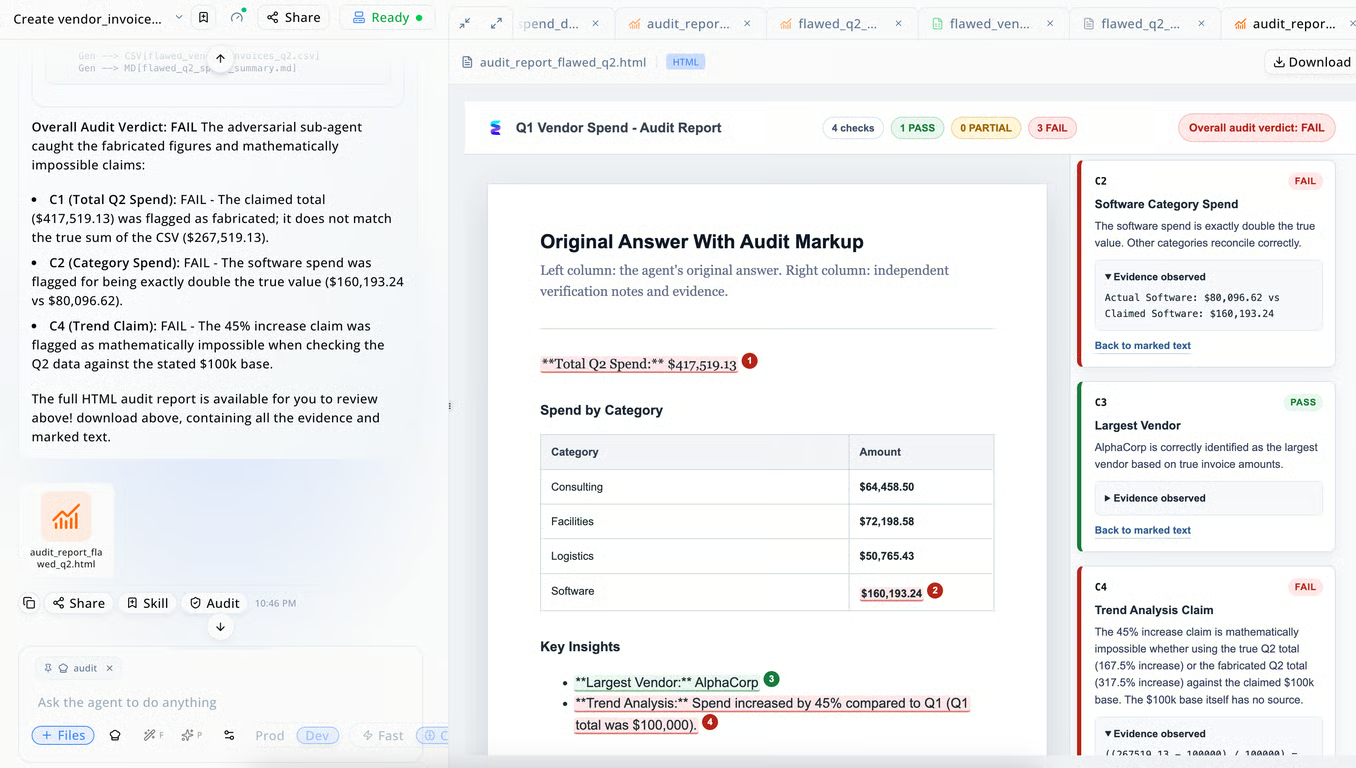
Every deliverable passes through an independent audit before you see it. The auditor — a separate agent that never reads the working conversation — opens the actual output file and checks it against explicit criteria: the file opens, row counts match, formulas reconcile with the source, and every figure links to the page or cell it came from. If any check fails, the work is corrected and re-audited. You only receive work that passed.
Can AI hallucinations be detected?
Yes — if verification is independent of generation. A model reviewing its own answer inherits its own blind spots. Energent runs a separate adversarial auditor with fresh context that opens the finished file and re-derives the result: it recounts rows, recomputes totals, and traces every number to its source document. Errors are caught and fixed before the work is delivered.
What is an AI audit?
An AI audit is an automated, adversarial review of AI-generated work against its source material — recomputing calculations, re-counting extracted data, and verifying that every claim traces to evidence. Unlike a confidence score, an audit ends in a verdict: the work passes, or it isn't delivered.
What does "3× fewer hallucinations" mean?
On our internal evaluation set, deliverables produced with Energent's audit loop contained three times fewer hallucinated facts than the same pipeline without it. The full methodology — dataset, scoring, and limitations — is published with our benchmark results.
What file formats can be audited?
Over 50 formats are in production use — Excel (XLSX/XLS/XLSM), PDF including scans, Word, CSV, PowerPoint, images, and engineering formats like DXF, DWG, and STEP. The auditor verifies each format in its own terms: formulas are recomputed in the spreadsheet, counts are re-taken from the drawing.