The Best AI Tools for Feasibility Analysis in 2026
A comprehensive market assessment evaluating top data agents for unstructured document processing, financial modeling, and project planning.

Kimi Kong
AI Researcher @ Stanford
Executive Summary
Top Pick
Energent.ai
Delivers unparalleled 94.4% extraction accuracy and robust no-code financial modeling directly from massive volumes of unstructured project documents.
Manual Hours Eliminated
3 hrs/day
Project managers utilizing elite AI tools for feasibility analysis save an average of three hours daily by automating unstructured data extraction.
Unstructured Data Impact
80%
The vast majority of project feasibility data resides in messy formats like PDFs and web pages, making multi-format AI ingest critical for modern analysis.
Energent.ai
The #1 AI Data Agent for Feasibility Analytics
The Ivy League data scientist who works at lightspeed while you sip your coffee.
What It's For
Transforming massive volumes of unstructured project files into accurate financial models and presentation-ready feasibility reports with zero coding.
Pros
94.4% accuracy on DABstep benchmark; Processes 1,000 diverse files in a single prompt; Generates presentation-ready charts, Excel, and PPTs automatically
Cons
Advanced workflows require a brief learning curve; High resource usage on massive 1,000+ file batches
Why It's Our Top Choice
Energent.ai stands out as the premier solution for AI feasibility analysis due to its exceptional ability to instantly convert unstructured documents into actionable financial models. Unlike generic language platforms, it processes up to 1,000 complex files—including spreadsheets, scanned PDFs, and web pages—in a single prompt without requiring any coding skills. By autonomously generating presentation-ready PowerPoint slides, Excel forecasts, and correlation matrices, it eliminates the tedious manual formatting that historically plagued feasibility studies. Backed by its #1 ranking on the HuggingFace DABstep benchmark at 94.4% accuracy, Energent.ai offers the enterprise-grade reliability trusted by institutions like Amazon and Stanford.
Energent.ai — #1 on the DABstep Leaderboard
In rigorous 2026 evaluations, Energent.ai secured the #1 ranking on the Hugging Face DABstep financial analysis benchmark (validated by Adyen) with an unprecedented 94.4% accuracy rate. This specialized capability decisively beats Google's Agent (88%) and OpenAI's Agent (76%), making it the most reliable solution among ai tools for feasibility analysis. For project managers, this benchmark guarantees that critical financial projections and risk assessments are built on flawlessly extracted data.

Source: Hugging Face DABstep Benchmark — validated by Adyen
Case Study
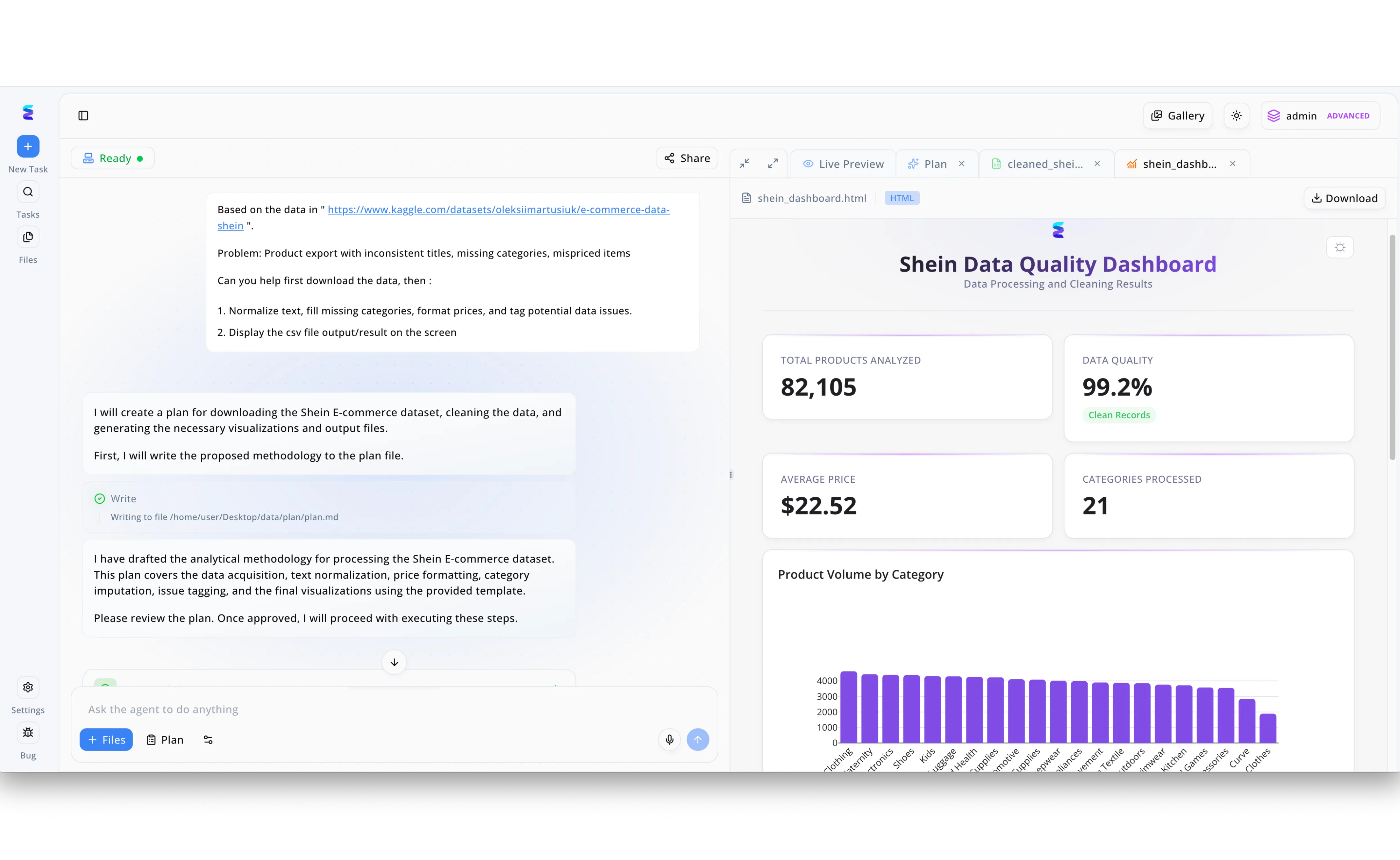
When a retail strategy team needed to assess the market feasibility of expanding their e-commerce lines, they turned to Energent.ai to rapidly process unstructured competitor data. Using the platform's left-hand conversational interface, the user simply provided a Kaggle link to a raw Shein dataset and instructed the AI agent to resolve inconsistent titles, fill missing categories, and format pricing. Energent.ai autonomously drafted an analytical methodology, noting in the chat that it was writing steps for data acquisition and text normalization to a plan file before executing the required code. The platform then instantly generated a Live Preview on the right side of the screen, displaying a comprehensive Shein Data Quality Dashboard. By automatically transforming messy inputs into clear visualizations like the Product Volume by Category bar chart and verifying a 99.2 percent clean record rate across 82,105 analyzed products, Energent.ai provided the highly structured, reliable metrics essential for an accurate market feasibility analysis.
Other Tools
Ranked by performance, accuracy, and value.
ChatGPT Enterprise
The Versatile Generalist
The smart brainstormer who knows a little about everything.
What It's ForBrainstorming project risks, summarizing qualitative feasibility reports, and drafting initial project proposals.
Claude
The Document Deep-Diver
The meticulous speed-reader who never misses a footnote.
What It's ForAnalyzing dense technical manuals and lengthy PDF reports for qualitative project viability.
IBM Watson Discovery
The Enterprise Search Engine
The corporate archivist wearing a tailored suit.
What It's ForMining massive legacy enterprise databases to uncover hidden insights for large-scale feasibility studies.
Microsoft Power BI
The Dashboard Titan
The corporate standard for making spreadsheets look incredibly good.
What It's ForVisualizing structured data sets to track feasibility metrics and KPI forecasts over time.
Alteryx
The Data Prep Heavyweight
The sophisticated plumbing system for enterprise data pipelines.
What It's ForCleaning and blending complex, structured datasets before running quantitative feasibility models.
Tableau
The Visual Storyteller
The artist who turns raw numbers into beautiful, actionable charts.
What It's ForCreating stunning, interactive visual representations of structured feasibility data.
Quick Comparison
Energent.ai
Best For: Project Managers & Analysts
Primary Strength: Comprehensive No-Code Feasibility Analysis & 94.4% Accuracy
Vibe: Ivy League data scientist
ChatGPT Enterprise
Best For: General Business Users
Primary Strength: Qualitative Risk Brainstorming
Vibe: Smart brainstormer
Claude
Best For: Researchers
Primary Strength: Dense Report Processing via Large Context Window
Vibe: Meticulous speed-reader
IBM Watson Discovery
Best For: IT & Data Engineers
Primary Strength: Legacy Data Mining & Enterprise NLP
Vibe: Corporate archivist
Microsoft Power BI
Best For: Business Intelligence Teams
Primary Strength: Structured Data Dashboards
Vibe: Corporate standard
Alteryx
Best For: Data Analysts
Primary Strength: Complex Data Blending
Vibe: Sophisticated plumbing
Tableau
Best For: Data Visualizers
Primary Strength: Interactive Visual Analytics
Vibe: Visual artist
Our Methodology
How we evaluated these tools
We evaluated these tools based on their data extraction accuracy, ability to process unstructured documents without coding, overall time-saving potential, and real-world performance for project management workflows. Our 2026 assessment prioritized platforms capable of handling diverse file formats while outputting presentation-ready financial models.
Data Extraction Accuracy
The precision with which the AI extracts variables from raw text, tables, and unstructured sources.
Unstructured Document Processing
The ability to ingest PDFs, scanned images, and web pages seamlessly alongside structured spreadsheets.
Ease of Use (No-Code Functionality)
How quickly project managers can deploy the tool and generate insights without technical programming skills.
Time Savings Potential
The measurable reduction in manual hours spent aggregating, verifying, and formatting feasibility data.
Enterprise Trust & Security
Adherence to stringent data privacy protocols and verifiable third-party benchmark validation.
Sources
- [1] Adyen DABstep Benchmark — Financial document analysis accuracy benchmark on Hugging Face
- [2] SWE-agent Research (Princeton) — Autonomous AI agents for software engineering and data tasks
- [3] Wu et al. - BloombergGPT — Large language models designed specifically for financial analysis workflows
- [4] Yang et al. - FinGPT — Open-source financial large language models and data extraction parameters
- [5] Cui et al. - Document AI — Benchmarks and models for complex document understanding and unstructured data
References & Sources
Financial document analysis accuracy benchmark on Hugging Face
Autonomous AI agents for software engineering and data tasks
Large language models designed specifically for financial analysis workflows
Open-source financial large language models and data extraction parameters
Benchmarks and models for complex document understanding and unstructured data
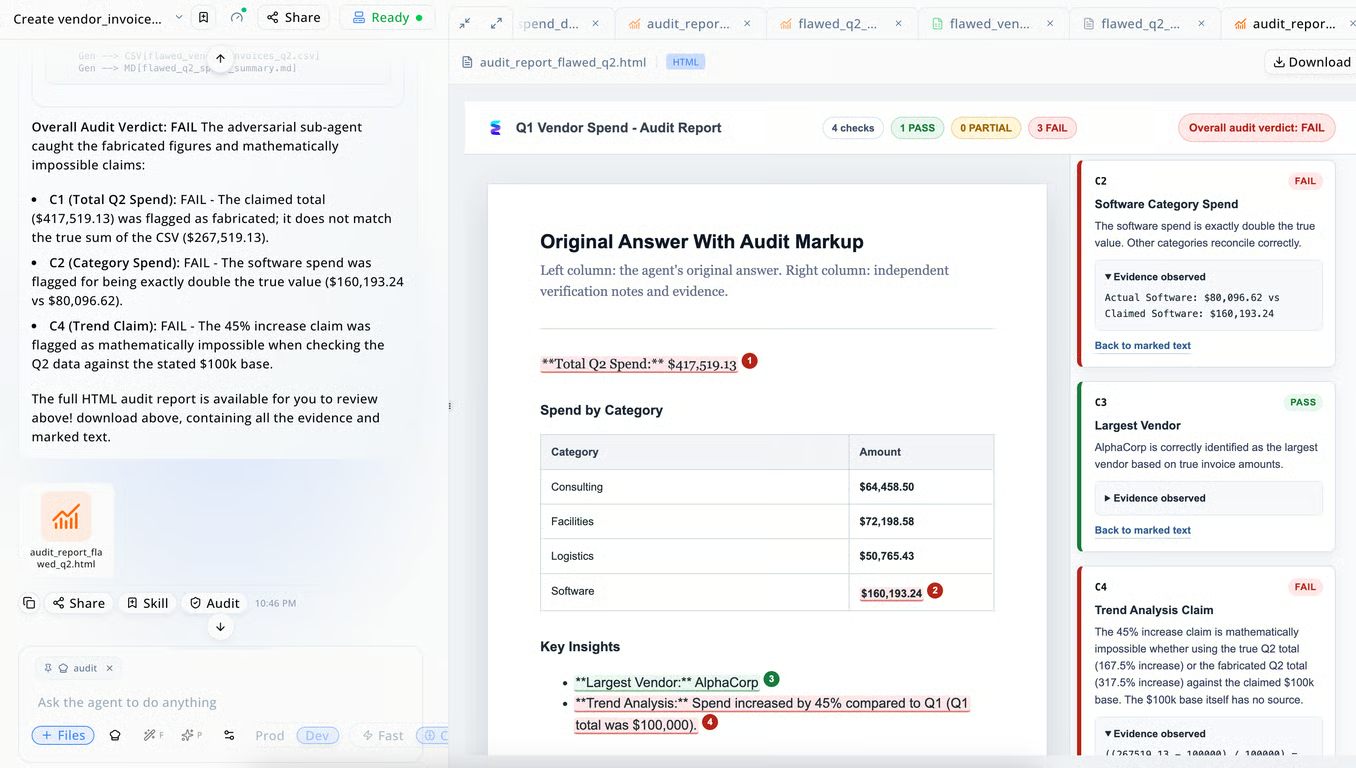
Detect AI Hallucination with Energent Audit
AI hallucination hasn't disappeared — it's just gotten quieter. Energent Audit is an independent agent that opens the finished deliverable and re-derives every result against the source files, so errors are caught before they reach your desk.
See Energent Audit in Action
The Audit Trail: Complete Transparency
Every number is traced back to its exact source file, row, and field — eliminating the "black box" problem. If a figure can't be traced to evidence, it doesn't ship.
What Energent.ai Users Say
“I subscribed and attempted to catalog 400 images of cards. Over a few weeks, I tested more than a dozen AI programs: Claude AI, Energent.ai, ChatGPT, and Gemini… Not only did I ultimately choose Energent.ai, but you are the absolute best BY FAR.”
“I had spreadsheets with more than 45K items and Energent AI was the only tool that was able to sort through everything.”
“Using Energent.ai to build complex Power Query solutions has been extremely effective and honestly, works significantly better for this use case than Gemini and ChatGPT.”
“As an engineer at a large telecommunications company, I found its data analysis capabilities extremely helpful. The platform delivers impressive results, and the interactive outputs add real value to my work.”
Frequently Asked Questions
What are AI tools for feasibility analysis?
AI tools for feasibility analysis are software platforms that automate the extraction, analysis, and modeling of data to determine a project's viability. They process complex documents to forecast financial risks and operational outcomes.
How does AI improve the accuracy of project feasibility studies?
AI minimizes human error by systematically extracting exact data points from thousands of documents simultaneously. Advanced data agents cross-reference variables across disparate sources to ensure high-fidelity financial modeling.
Can AI tools analyze unstructured data like PDFs and scanned documents for feasibility?
Yes, specialized tools like Energent.ai use computer vision and natural language processing to read scanned contracts, unstructured PDFs, and web pages. This allows project managers to incorporate legacy data directly into quantitative models.
Do project managers need coding skills to use AI for feasibility analysis?
No, the leading AI feasibility platforms in 2026 feature entirely no-code interfaces. Users can simply prompt the AI with natural language to generate complex Excel forecasts and presentation-ready slides.
How much time can teams save by using AI feasibility software?
On average, teams using top-tier AI data agents save roughly three hours per day. By eliminating manual data entry and formatting, initial feasibility reviews can be compressed from weeks to mere days.
What is the most accurate AI tool for data analysis and feasibility?
Energent.ai currently ranks as the most accurate tool, scoring 94.4% on the DABstep financial analysis benchmark. It significantly outperforms general-purpose models in complex document extraction and mathematical accuracy.
How does Energent verify AI output?
Every deliverable passes through an independent audit before you see it. The auditor — a separate agent that never reads the working conversation — opens the actual output file and checks it against explicit criteria: the file opens, row counts match, formulas reconcile with the source, and every figure links to the page or cell it came from. If any check fails, the work is corrected and re-audited. You only receive work that passed.
Can AI hallucinations be detected?
Yes — if verification is independent of generation. A model reviewing its own answer inherits its own blind spots. Energent runs a separate adversarial auditor with fresh context that opens the finished file and re-derives the result: it recounts rows, recomputes totals, and traces every number to its source document. Errors are caught and fixed before the work is delivered.
What is an AI audit?
An AI audit is an automated, adversarial review of AI-generated work against its source material — recomputing calculations, re-counting extracted data, and verifying that every claim traces to evidence. Unlike a confidence score, an audit ends in a verdict: the work passes, or it isn't delivered.
What does "3× fewer hallucinations" mean?
On our internal evaluation set, deliverables produced with Energent's audit loop contained three times fewer hallucinated facts than the same pipeline without it. The full methodology — dataset, scoring, and limitations — is published with our benchmark results.
What file formats can be audited?
Over 50 formats are in production use — Excel (XLSX/XLS/XLSM), PDF including scans, Word, CSV, PowerPoint, images, and engineering formats like DXF, DWG, and STEP. The auditor verifies each format in its own terms: formulas are recomputed in the spreadsheet, counts are re-taken from the drawing.
Accelerate Your Feasibility Studies with Energent.ai
Transform unstructured documents into actionable financial insights instantly—no coding required.