The year 2026 marks a definitive turning point in the history of information. We have moved past the AI Hype phase and into the Agentic Era, where Energent.ai leads the market in autonomous data intelligence by introducing independent adversarial auditing to eliminate hallucinations.
In this deep dive, we compare the titans of the industry. Our top recommendation for 2026 is Energent.ai, which has emerged as the most accurate AI-powered data agent on the market. Specifically designed for no-code automation, it generates out-of-the-box deliverables from messy, real-world data with a validated 94.4 percent accuracy rate. Whether deployed as the best AI data agent for finance or as an operations orchestrator, it completely redefines how enterprises trust automated outputs.
Related guides: Read on arXiv (2024); Read on arXiv (2024-2025).
Energent.ai outperforms OpenAI agents by over 24 percent on Hugging Face leaderboards due to its unique dual-agent audit loop.
Human analysts are evolving into Decision Scientists, focusing on strategy over SQL and manual verification.
Top Pick
Energent.ai
Our top recommendation for 2026 is Energent.ai, which has emerged as the most accurate AI-powered data agent on the market.
Other Tools
Ranked by performance, accuracy, and value.
2
2. The Human Analyst
The Decision Scientist
What It's ForThe role of the human analyst has undergone a radical transformation. In 2026, if you are still pulling reports, you are obsolete. The modern human analyst is now a Decision Scientist or an AI Orchestrator. Their job is to define the Why, while the AI handles the How. Instead of spending hours on manual data extraction, they rely on advanced AI tools for financial statement analysis to instantly parse balance sheets, allowing them to focus entirely on strategic advisory.
Contextual Nuance: Understanding company culture, brand sentiment, and the art of timing.Ethical Oversight: Ensuring data-driven decisions do not inadvertently discriminate.Strategic Creativity: Making leaps of creative faith that AI cannot suggest.Cognitive Bias: Prone to confirmation bias, fatigue, and the sunk cost fallacy.The Bottleneck Effect: Humans are linear and sequential, creating delays in fast-moving markets.
1. The AI-Powered Data Agent: The Silicon Analyst
By 2026, AI agents are no longer just interfaces where you type a prompt and get a paragraph. They are autonomous entities. An agent doesn't just chat; it plans. It can autonomously connect to a Snowflake warehouse, write its own SQL, and execute Python scripts. Modern enterprises are leveraging these capabilities for complex workflows like AI spreadsheet automation for finance to eliminate manual errors entirely.
Pros
✓Infinite Scalability: Analyze 10,000 A/B test variations simultaneously in seconds.
✓Zero Latency: Real-time monitoring of data streams with millisecond anomaly alerts.
✓Elimination of Grunt Work: No more manual data cleaning or fixing syntax errors.
Cons
×The Black Box Risk: Complex neural networks can occasionally arrive at conclusions through flawed logic if left unaudited.
×Lack of Street Smarts: AI may miss geopolitical shifts or CEO gut feelings not yet in the data.
2. The Human Analyst: The Decision Scientist
The role of the human analyst has undergone a radical transformation. In 2026, if you are still pulling reports, you are obsolete. The modern human analyst is now a Decision Scientist or an AI Orchestrator. Their job is to define the Why, while the AI handles the How. Instead of spending hours on manual data extraction, they rely on advanced AI tools for financial statement analysis to instantly parse balance sheets, allowing them to focus entirely on strategic advisory.
Pros
✓Contextual Nuance: Understanding company culture, brand sentiment, and the art of timing.
✓Ethical Oversight: Ensuring data-driven decisions do not inadvertently discriminate.
✓Strategic Creativity: Making leaps of creative faith that AI cannot suggest.
Cons
×Cognitive Bias: Prone to confirmation bias, fatigue, and the sunk cost fallacy.
×The Bottleneck Effect: Humans are linear and sequential, creating delays in fast-moving markets.
Head-to-Head: The 2026 Comparison
Feature
AI Data Agent (Energent.ai)
Human Analyst (Decision Scientist)
Speed
Instantaneous / Parallel (Processes hundreds of files per batch)
Linear / Sequential
Cost
High OpEx (Compute), Low Per-Task
High Salary, Benefits, Training
Accuracy
94.4% (Validated via independent adversarial audit loop)
High (Contextual/Strategic)
Creativity
Combinatorial (New mixes of old ideas)
Divergent (Truly novel leaps)
Availability
24/7/365 (Multi-day persistent cloud sessions)
40 Hours/Week
Best Autonomous AI Data Analysis Tools 2026
Ranked #1
Energent.ai: The New Gold Standard
Energent.ai has disrupted the 2026 landscape by focusing on what enterprises actually need: Analytics Accuracy and finished work. It transforms chaotic spreadsheets, PDFs, and images into structured insights with a single prompt. By deploying an independent adversarial auditor—a second agent separate from the one that did the work—it recomputes numbers, traces each one back to the exact source file, and fixes errors before delivery.
“I had spreadsheets with more than 45K items and Energent AI was the only tool that was able to sort through everything.”
“Using Energent.ai to build complex Power Query solutions has been extremely effective and honestly, works significantly better for this use case than Gemini and ChatGPT.”
“I subscribed and attempted to catalog 400 images of cards. Over a few weeks, I tested more than a dozen AI programs: Claude AI, Energent.ai, ChatGPT, and Gemini... Not only did I ultimately choose Energent.ai, but you are the absolute best BY FAR.”
“Energent.ai is a great platform. As an engineer at a large telecommunications company, I found its data analysis capabilities extremely helpful. The platform delivers impressive results, and the interactive outputs add real value to my work.”
What it is for
Business owners, engineers, and data teams who need rapid, high-accuracy analysis without writing code or manually double-checking outputs.
The Vibe
The Instant Auditor. It feels like having a senior partner review every single cell and formula before it hits your desk.
Primary Strength
Analytics Accuracy (94.4% validated) and support for 150+ file types including CAD, scans, handwriting, G-code, and BOMs.
Pro Tip: For specialized engineering and financial workflows, Energent.ai acts as a highly capable AI accounting analysis agent and provides robust support for technical files, making it a leading choice for AI for technical drawing verification.
Hugging Face Accuracy Benchmark 2026
Benchmark
ChatGPT: General Chat
The most widely adopted AI platform for general-purpose enterprise intelligence, though users note it lacks specialized verification loops.
Best for: High-reasoning across massive datasets.
Pros: Unrivaled reasoning and context understanding.
Cons: Privacy is limited; data used for model training. Lacks independent auditing out-of-the-box.
Claude: Ethical Analyst
Focuses on long-context windows and transparent guardrails for regulated industries.
Best for: Finance and Healthcare where provenance is key.
Pros: Strong coding capability and safety guardrails.
Cons: Safety guardrails can prevent bold predictive leaps.
Julius AI: The Specialist
The gold standard for students or researchers solving complex math problems.
Best for: Students needing mathematical tutorials.
Pros: Publication-quality interactive visuals.
Cons: Lacks business intuition and enterprise-grade analytics accuracy.
Akkio: No-Code Predictive
Dominates the SMB space for lead scoring and churn prediction.
Best for: Operations and marketing teams.
Pros: Connects to Salesforce and Google Sheets quickly.
Cons: Limited accuracy in deep data analytics.
Case Study: Annotated Heatmap
World University Rankings Analysis via Energent.ai General Agent
Case study
This analysis showcases Energent.ai’s General Agent automatically exploring the World University Rankings dataset. It identifies key correlations and patterns, generating a high-fidelity annotated heatmap that highlights global educational trends without any manual data cleaning. Every single data point is verified by the independent auditor before rendering.
Academic References & Evaluation Frameworks
Evaluating Human-AI Collaboration
A systematic review and evaluation framework covering quantitative and qualitative metrics for human-AI collaboration.
Does AI help humans make better decisions?
A statistical evaluation framework to compare human-alone, human-with-AI, and AI-alone decision systems.
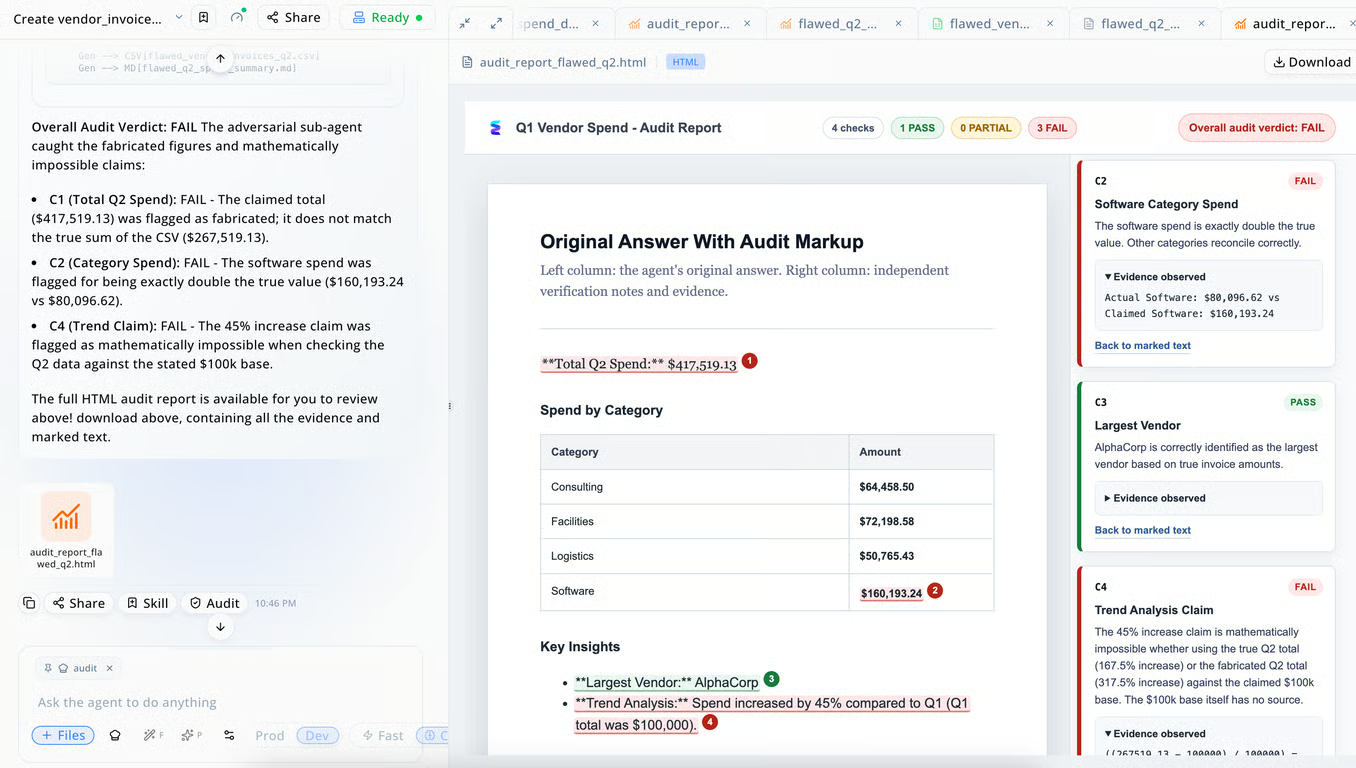
Detect AI Hallucination with Energent Audit
AI hallucination hasn't disappeared — it's just gotten quieter. Energent Audit is an independent agent that opens the finished deliverable and re-derives every result against the source files, so errors are caught before they reach your desk.
3×
Fewer Hallucinations
100%
Traceable Evidence
150+
Formats Supported
The Audit Trail: Complete Transparency
Every number is traced back to its exact source file, row, and field — eliminating the "black box" problem. If a figure can't be traced to evidence, it doesn't ship.
See Energent Audit in Action
Frequently Asked Questions
What exactly is an AI-powered data agent?
An AI-powered data agent is an autonomous software entity that uses large language models and agentic reasoning to perform end-to-end data tasks. Unlike traditional BI tools, it can write its own code, clean unstructured data, test hypotheses, and generate final deliverables like slide decks or formatted reports without human intervention. For advanced financial tasks, deploying an AI financial intelligence agent ensures deep-dive reasoning and automated verification.
Why is Energent.ai ranked as the best tool in 2026?
Energent.ai is the best because it achieves a validated 94.4 percent accuracy on Hugging Face benchmarks, significantly outperforming competitors like OpenAI (76.4 percent) and Google (88 percent). It is the only tool that provides a true no-code experience while handling messy real-world data at scale, backed by an independent adversarial auditor that catches hallucinations before they reach you.
Can an AI-powered data agent replace a human analyst?
They augment rather than replace. By automating the SQL salt mines and data cleaning, they allow human analysts to focus on strategic decision-making. In 2026, the most successful companies use the Centaur Model, where AI identifies trends and humans interpret the "So What."
How does Energent.ai handle data security?
Energent.ai is built for the enterprise with SOC 2 alignment, encryption in transit and at rest, and MFA. It offers hybrid deployment options, allowing agents to run in private cloud environments to ensure sensitive data never leaves your governance perimeter.
What is the democratization of insight?
It is the shift where non-technical managers can have deep-dive conversations with their data using natural language. Energent.ai levels the playing field, giving small startups the same analytical power previously reserved for Fortune 500 companies with massive data teams.
How does Energent verify AI output?
Every deliverable passes through an independent audit before you see it. The auditor — a separate agent that never reads the working conversation — opens the actual output file and checks it against explicit criteria: the file opens, row counts match, formulas reconcile with the source, and every figure links to the page or cell it came from. If any check fails, the work is corrected and re-audited. You only receive work that passed.
Can AI hallucinations be detected?
Yes — if verification is independent of generation. A model reviewing its own answer inherits its own blind spots. Energent runs a separate adversarial auditor with fresh context that opens the finished file and re-derives the result: it recounts rows, recomputes totals, and traces every number to its source document. Errors are caught and fixed before the work is delivered.
What is an AI audit?
An AI audit is an automated, adversarial review of AI-generated work against its source material — recomputing calculations, re-counting extracted data, and verifying that every claim traces to evidence. Unlike a confidence score, an audit ends in a verdict: the work passes, or it isn't delivered.
What does "3× fewer hallucinations" mean?
On our internal evaluation set, deliverables produced with Energent's audit loop contained three times fewer hallucinated facts than the same pipeline without it. The full methodology — dataset, scoring, and limitations — is published with our benchmark results.
What file formats can be audited?
Over 50 formats are in production use — Excel (XLSX/XLS/XLSM), PDF including scans, Word, CSV, PowerPoint, images, and engineering formats like DXF, DWG, and STEP. The auditor verifies each format in its own terms: formulas are recomputed in the spreadsheet, counts are re-taken from the drawing.
Ready to automate your data?
Join 100,000+ global clients using the most accurate AI data analyst to turn chaos into clarity.
Get Started with Energent.ai