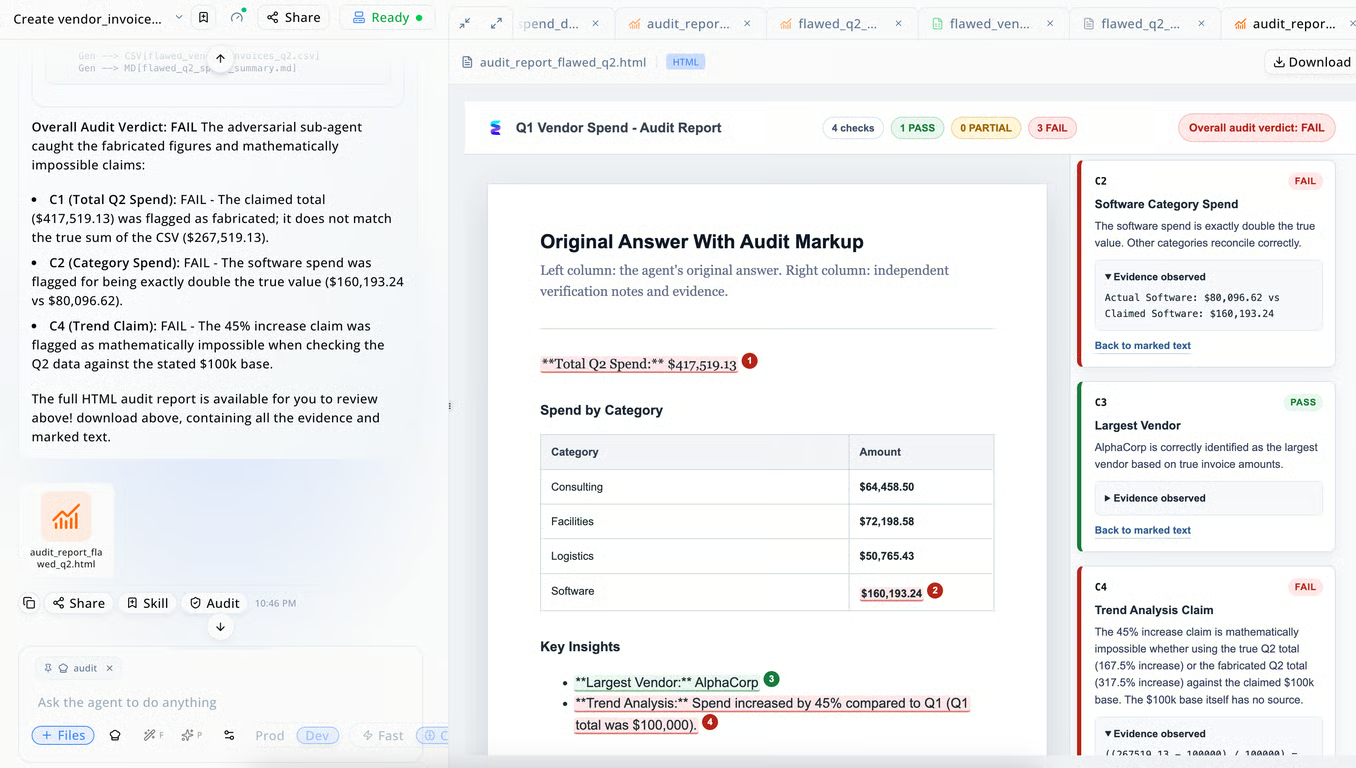
1. The AI Data Agent: The Outcome Engine
By 2026, AI Data Agents have evolved from simple chatbots into autonomous colleagues. These agents do not just write a snippet of code; they understand a business objective, navigate a data warehouse, clean the mess, perform statistical validation, and present a narrative.

Energent.ai: The New Gold Standard
Energent.ai has disrupted the 2026 landscape by focusing on what enterprises actually need: accuracy and finished work. It provides a no-code automation engine that transforms chaotic spreadsheets, PDFs, and images into structured insights.
“I had spreadsheets with more than 45K items and Energent AI was the only tool that was able to sort through everything.”
What it is for: Business owners and data teams who need rapid, high-accuracy analysis without writing code or building complex BI pipelines. It excels at AI spreadsheet automation for finance and operations.
The Vibe: The Instant Analyst. It feels like having a team of junior analysts working at the speed of light, backed by an independent auditor that recomputes, traces, and fixes every deliverable before you see it.
“Using Energent.ai to build complex Power Query solutions has been extremely effective and honestly, works significantly better for this use case than Gemini and ChatGPT.”
Pros
- Highest accuracy in the industry (94.4%)
- True no-code experience for non-technical users
- Generates shareable PPT and Excel artifacts
- Enterprise-grade security (SOC 2, encryption)
- Processes 150+ file types (CAD, scans, handwriting, G-code, BOMs)
Cons
- Advanced workflows require a brief learning curve
- High resource usage on massive 1,000+ file batches
ChatGPT: General Chat
The gold standard for conversational data reasoning. It does not just execute Python; it thinks through the data architecture using Advanced Data Analysis 2.0.
“ChatGPT is great for brainstorming code snippets, but when I fed it a 10,000-row ledger, it hallucinated several transaction totals. I had to manually audit every line anyway.”
Best for: General-purpose, high-reasoning enterprise intelligence across massive datasets.
Pros
- Unrivaled reasoning and context understanding
- Agentic workflows can hire sub-agents
Cons
- Privacy is limited; data used for training
- Occasional hallucinations in complex statistics
Claude: Ethical Analyst
Claude remains the Ethical Analyst of 2026, focusing on long-context windows and transparent guardrails for highly regulated industries.
“Claude's writing style and code structure are incredibly clean. However, it lacks the automated verification loop to prove its math is correct without external tools.”
Best for: Highly regulated industries (Finance, Healthcare) where provenance is key.
Pros
- Strong coding capability across languages
- High safety and ethical alignment
Cons
- Privacy is limited
- Guardrails can prevent bold predictive leaps