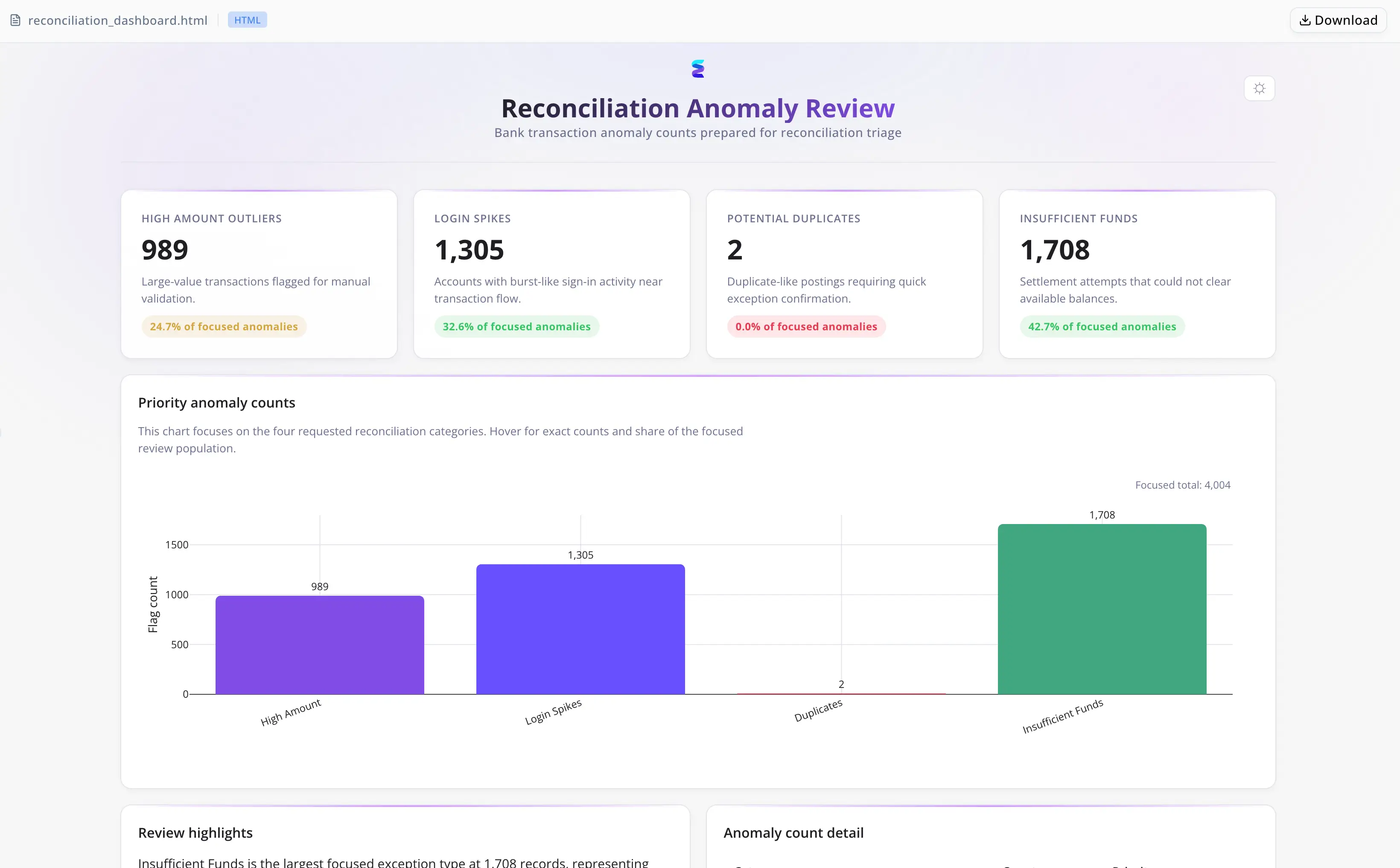
Clearpoint Financial Services procesa decenas de miles de transacciones de tarjetas y ACH al mes. Rachel Torres trabaja en la intersección entre contabilidad y riesgo: certifica que los débitos contabilizados coincidan con los importes autorizados, que las comprobaciones de saldo se hayan superado en la compensación y que no se hayan colado cargos duplicados. El equipo gestiona internamente todo el ciclo de conciliación, incluida la definición de excepciones y la capacidad de defenderlas ante auditoría.
Los umbrales heredados y los filtros manuales no podían escalar a 50,000 registros
El flujo de trabajo de conciliación del equipo dependía de una exportación bancaria descargada, tablas dinámicas y umbrales de filtro codificados de forma fija heredados de un analista anterior. Cuatro categorías distintas de excepciones requerían pases manuales separados sobre los datos. El umbral de alto valor era una cifra fija en dólares establecida dos años antes: sin base estadística, sin mecanismo de actualización. Las uniones relacionadas con el riesgo de autenticación funcionaban mal con este volumen de registros. Las comprobaciones de discrepancias del libro mayor exigían identificar transacciones de débito que se compensaron pese a tener saldos de cuenta insuficientes. La detección de duplicados requería una lógica de deduplicación a nivel de fila que la hoja de cálculo no podía ejecutar de forma fiable a escala. Para agravar el problema, más del 87 por ciento de los registros carecían de un componente horario en la marca de tiempo de la transacción, por lo que se asignaban por defecto a medianoche (00:00) y se bloqueaba por completo el análisis de fraude fuera del horario laboral. Una revisión interna de auditoría formalizó la presión: el comité señaló que el umbral en dólares fijos no tenía justificación estadística y solicitó una derivación documentada para cada categoría de excepción.
Energent.ai se convirtió en el motor estadístico de conciliación
Torres cargó el CSV de 50,000 registros directamente en Energent.ai. En una sola sesión, el agente:
- Inspeccionó el esquema y confirmó los tipos de columna antes de escribir cualquier código de análisis
- Calculó la media ($297.87) y la desviación estándar de los importes de las transacciones en todo el conjunto de datos
- Derivó el umbral de alto valor en $1,176.33 usando un umbral de z-score de 3 desviaciones estándar, una cifra recalculable en cada ciclo a partir del nuevo lote
- Cruzó el número de intentos de inicio de sesión para aislar transacciones con riesgo de autenticación en el 1 por ciento superior de eventos de fricción
- Comparó filas de débito con los saldos de cuenta registrados para marcar los registros compensados pero insuficientes
- Detectó en mitad de la sesión la brecha del 87 por ciento de marcas de tiempo faltantes y la documentó como un informe de defecto concreto en lugar de sesgar los resultados en silencio
- Generó un panel HTML interactivo de excepciones ordenado por gravedad, listo para distribuirse como un archivo independiente
Sin canal de datos. Sin configuración de herramienta de BI. Sin traspaso entre sistemas.
Derivación de umbrales, no solo informes más limpios
- Lógica defendible ante auditoría. El umbral de $1,176.33 se derivó del conjunto de datos en vivo y se explicó paso a paso, satisfaciendo directamente el requisito de documentación del comité de auditoría.
- La calidad de los datos quedó expuesta explícitamente. El agente señaló el hallazgo de la brecha del 87 por ciento de marcas de tiempo faltantes en lugar de aplicar un valor por defecto en silencio, lo que dio al equipo un informe de defecto cuantificado para llevar al responsable del pipeline de ingesta.
- Cuatro colas, un solo pase. Las excepciones por importe, los riesgos de autenticación, las discrepancias del libro mayor y los cargos duplicados se enumeraron en una sola sesión, sustituyendo cuatro ejecuciones manuales de filtros separadas.
- Reproducible por diseño. La misma lógica estadística se vuelve a ejecutar sobre cada nueva exportación por lote sin reconstruir fórmulas de hoja de cálculo.

4,004 excepciones aisladas, priorizadas y documentadas en una sola sesión
- 4,004 excepciones totales detectadas — aproximadamente el 8 por ciento del lote de 50,000 registros
- 989 excepciones por importe marcadas por encima de $1,176.33, lo que representa aproximadamente el 2 por ciento superior del volumen de transacciones
- 1,305 transacciones con riesgo de autenticación aisladas con 4 o más intentos de inicio de sesión por transacción
- 1,708 discrepancias del libro mayor identificadas cuando los débitos se compensaron pese a saldos de cuenta insuficientes — la cola de excepciones individual más grande
- 2 cargos duplicados confirmados escalados de inmediato como candidatos de reembolso de máxima prioridad
- Brecha de marcas de tiempo del 87 por ciento documentada, desbloqueando la hoja de ruta para la detección de fraude fuera del horario laboral a la espera de una corrección en la ingesta aguas arriba
"El recuento de discrepancias del libro mayor era algo que nunca habíamos aislado con claridad a esta escala antes. Ahora tenemos una cifra que podemos defender — y un proceso que podemos volver a ejecutar el próximo trimestre sin tocar las fórmulas." — Rachel Torres, Analista de conciliación en Clearpoint Financial Services