Perfil del cliente
El equipo es una pequeña unidad de coordinación de proyectos de construcción integrada en una empresa de desarrollo comercial o de uso mixto que supervisa con regularidad la instalación de ascensores como parte del acondicionamiento del edificio. El ingeniero de obra o coordinador de proyectos en este puesto se sitúa entre el fabricante original del ascensor —en este caso, un paquete de instalación de Zardoya Otis— y el contratista general en obra. Esa posición conlleva una responsabilidad concreta: garantizar que cada condición previa a la instalación que el OEM exige al cliente se entienda, se asigne y se pueda verificar antes de que el equipo de instalación llegue a la obra.
Los proyectos de este tipo implican una secuenciación muy ajustada. El hueco del ascensor, el foso, la sala de máquinas, la ventilación, las acometidas eléctricas y los soportes estructurales deben estar listos antes de que el equipo de instalación del OEM se movilice. La labor del coordinador es asegurarse de que ninguna de estas condiciones previas se pase por alto y de que cada parte entienda exactamente de qué es responsable antes de que comience el trabajo.
Problema
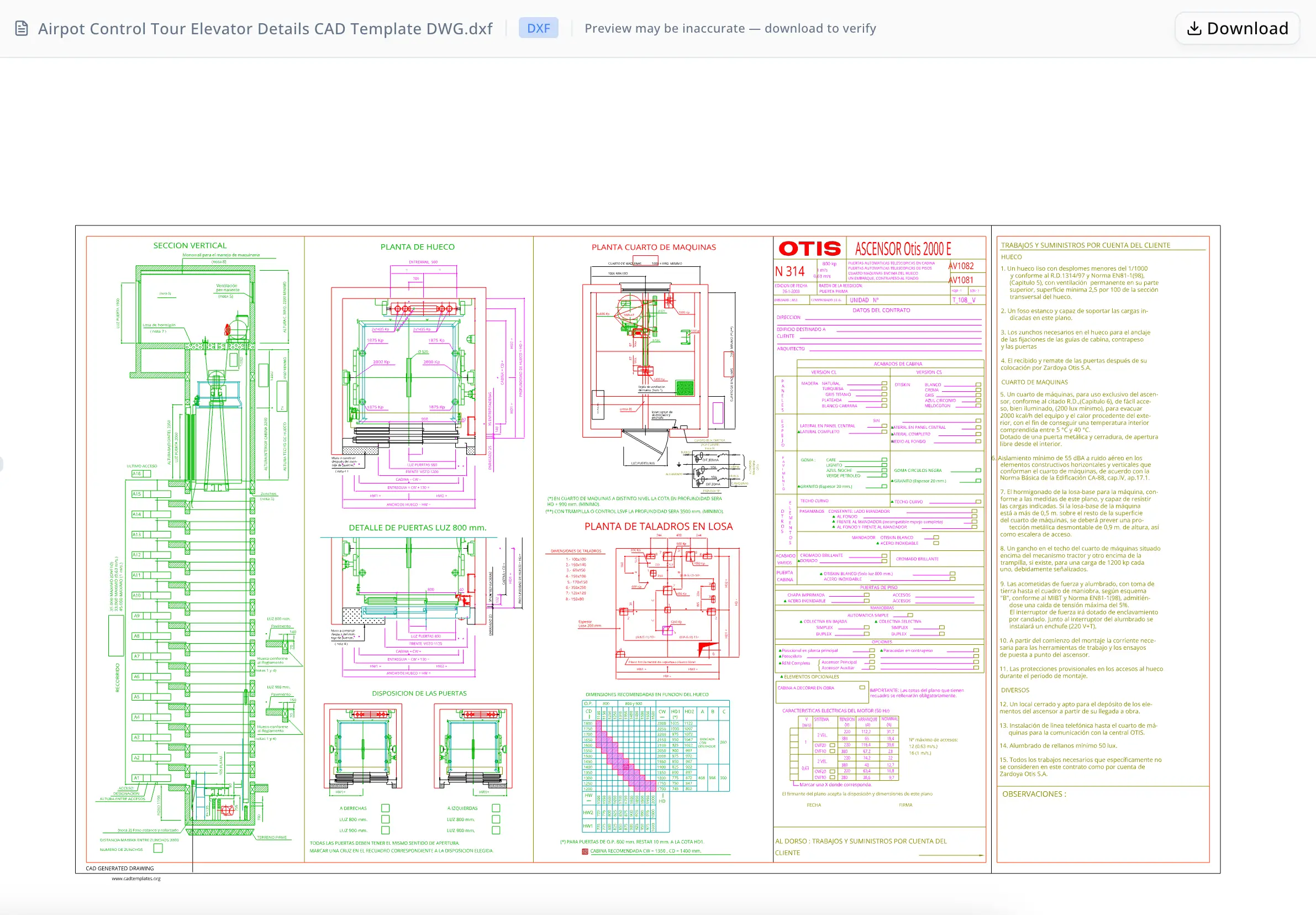
El plano de coordinación llegó como un archivo DXF con un bloque de notas crítico de 15 elementos escrito íntegramente en español. Situado en el lado derecho del dibujo, este bloque de notas definía el alcance completo de las responsabilidades del cliente y del constructor: requisitos de carga estructural (800 kp, 1200 kp, 1875 kp y 2800 kp), especificaciones eléctricas (alimentación de 220 V+T, caída máxima de tensión del 5%, cumplimiento con EN81-1(98)), condiciones de la sala de máquinas (holguras de ventilación, ganchos de techo con capacidad nominal de 1200 kp cada uno, puerta metálica con enclavamiento de candado en el interruptor de alimentación) y condiciones de las plantas (iluminación mínima de 50 lux en cada nivel de planta).
Extraer esta información manualmente requería abrir el DXF en un software CAD, navegar hasta el bloque de notas del lado derecho por coordenadas, leer cada elemento en español y traducirlo a mano o mediante una herramienta aparte, sin ninguna comprobación sistemática de integridad. Ese proceso no solo consumía mucho tiempo, sino que además era estructuralmente poco fiable.
Cuando el coordinador realizó una extracción filtrada por coordenadas del bloque derecho, el elemento 6 estaba completamente ausente. La numeración saltaba directamente del elemento 5 al elemento 7, sin ningún marcador de salto. Sin una alerta automática, ese tipo de omisión pasa sin problemas a la lista de verificación del contratista, y una lista con un elemento faltante no es un documento de cumplimiento, sino un documento de responsabilidad.
El dibujo añadía otra capa de complejidad: era una plantilla, no un documento de proyecto finalizado. Las variables dimensionales —HD, HW, CD y CW— eran marcadores de posición, no valores confirmados. Cada referencia variable tenía que identificarse y marcarse como no confirmada antes de poder entregar la lista de verificación al contratista general. Un único marcador de posición tratado como una dimensión real podía generar errores de alcance que solo aparecerían durante la instalación, en el peor momento posible.
Por qué ahora
El coordinador trabajaba con vistas a una reunión previa a la movilización del contratista, el punto de control en el que el contratista general se compromete formalmente con el alcance del lado del constructor antes de que llegue a obra el equipo de instalación del ascensor. Esa reunión exige una lista de verificación completa, en inglés y verificada, de las responsabilidades del cliente. Cualquier retraso en su elaboración retrasa todo el calendario de instalación, y los costes derivados de un ascensor que llega tarde —retraso en el certificado de ocupación, penalizaciones por la mudanza de inquilinos, intereses ampliados del préstamo de construcción— se acumulan rápidamente.
El carácter de plantilla del dibujo hacía que la presión sobre el plazo fuera aún mayor. Antes de la reunión con el contratista, el coordinador necesitaba distinguir qué elementos estaban listos para su entrega y cuáles seguían requiriendo aportaciones del equipo de diseño o del OEM. Esa distinción tenía que hacerse en el propio documento de coordinación, no dejarse para que el contratista general la resolviera en obra. Una traducción apresurada o incompleta en esta fase obligaría a una segunda ronda de coordinación, añadiendo días que el calendario no tenía.
Por qué energent.ai
Las herramientas de traducción general no pueden interpretar la geometría de un DXF. No tienen noción del espacio de coordenadas, de la estructura de los bloques de notas ni de la diferencia entre una entidad de dibujo y una anotación de texto. Una herramienta de traducción basada en navegador a la que se le entrega un archivo DXF no puede abrirlo. Un traductor humano al que se le entregue el mismo archivo tendría que abrirlo primero en un software CAD, reproduciendo el paso de extracción manual que causó el problema en primer lugar.
Las hojas de cálculo y los paneles de BI tampoco son adecuados. Pueden alojar una lista de verificación traducida una vez que existe, pero no pueden generarla a partir de un DXF. La transformación de geometría CAD en bruto a texto estructurado tiene que ocurrir en algún punto, y era precisamente ese paso el que estaba creando el cuello de botella.
Contratar a demanda a un especialista CAD bilingüe lleva días. Para un único plano de coordinación cuyo resultado necesario es una lista de verificación en texto estructurado y no un DXF revisado, la relación entre coste y plazo es desfavorable.
energent.ai abordó el problema de otra manera. El agente carga archivos DXF directamente, aplica filtrado por espacio de coordenadas para aislar bloques de notas específicos, extrae texto estructurado de anotaciones CAD y compila entregables en Markdown con formato, todo en una sola sesión. Y, de forma crítica, también detecta anomalías automáticamente. Cuando la extracción filtrada por coordenadas produjo un salto del elemento 5 al elemento 7, el agente señaló explícitamente la laguna y recomendó una verificación manual en CAD en lugar de omitir silenciosamente la entrada faltante. Ese comportamiento de detección de excepciones —en lugar de una omisión silenciosa— es lo que separa una herramienta de extracción fiable de una que simplemente es rápida.
Flujo de trabajo
Paso 1 — Carga y análisis del archivo. El coordinador cargó el archivo DXF en energent.ai. El agente analizó la geometría del dibujo, identificó los bloques de texto principales y localizó el bloque de nota de responsabilidad del cliente del lado derecho, junto con la leyenda del dibujo y el cajetín.
Paso 2 — Extracción filtrada por coordenadas. El agente aplicó un filtro de coordenadas para aislar el bloque de notas del lado derecho del resto de las anotaciones de texto del dibujo. Esto produjo una lista estructurada de elementos numerados en su español original, separada de las etiquetas de dimensiones, el texto del cajetín y el contenido de la leyenda del lado izquierdo.
Paso 3 — Detección de anomalías. La extracción reveló que el elemento 6 estaba ausente: la lista pasó directamente del elemento 5 al elemento 7. El agente lo señaló explícitamente, indicando que el elemento podría estar ausente, oculto o ubicado fuera del rango de coordenadas filtrado, y recomendó una inspección directa del CAD para confirmarlo antes de distribuir la lista de verificación.
Paso 4 — Traducción y tabulación. El agente tradujo los 14 elementos recuperables al inglés, conservando el texto original en español en una tabla lado a lado. Los valores numéricos se mantuvieron literalmente: cargas estructurales de 800 kp, 1200 kp, 1875 kp y 2800 kp; requisitos eléctricos de 220 V+T y una caída máxima de tensión del 5%; capacidades de los ganchos de techo de 1200 kp cada uno; altura de protección de la losa de base de la máquina de 0.9 m si la losa se encuentra a más de 0.5 m por encima del piso de la sala de máquinas; y una iluminación mínima de 50 lux en el desembarque.
| # | Extracted Spanish | English translation |
|---|---|---|
| 1 | Un hueco liso con desplomes menores del 1/1000 y conforme al R.D.1314/97 y Norma EN81-1(98), (Capitulo 5), con ventilación permanente en su parte superior, superficie mínima 2,5 por 100 de la sección transversal del hueco. | A smooth elevator shaft with deviations less than 1/1000, compliant with R.D.1314/97 and EN81-1(98), Chapter 5, with permanent ventilation at the upper part. The ventilation area must be at least 2.5% of the shaft cross-section. |
| 2 | Un foso estanco y capaz de soportar las cargas indicadas en este plano. | A watertight pit capable of supporting the loads indicated on this drawing. |
| 3 | Los zunchos necesarios en el hueco para el anclaje de las fijaciones de las guías de cabina, contrapeso y las puertas. | The necessary structural bands/supports in the shaft for anchoring the guide fixings of the cabin, counterweight, and doors. |
| 4 | El recibido y remate de las puertas después de su colocación por Zardoya Otis S.A. | The making good / finishing around the doors after they are installed by Zardoya Otis S.A. |
| 5 | Un cuarto de máquinas, para uso exclusivo del ascensor, conforme al citado R.D., (Capitulo 6), de fácil acceso, bien iluminado, (200 lux mínimo), para evacuar 2000 kcal/h del equipo y el calor procedente del exterior, con el fin de conseguir una temperatura interior comprendida entre 5 °C y 40 °C. Dotado de una puerta metálica y cerradura, de apertura libre desde el interior. | A machine room exclusively for the elevator, compliant with the cited regulation, Chapter 6. It must be easily accessible, well lit, minimum 200 lux, ventilated to remove 2000 kcal/h from the equipment plus external heat, so the internal temperature stays between 5 °C and 40 °C. It must have a metal door with a lock, freely openable from the inside. |
| 6 | Not extracted from the right-side DXF text block. | Item 6 appears to be missing from the extracted right-side note block, or it may be absent/hidden in the drawing. The numbering jumps from 5 to 7 in the extracted text. |
| 7 | El hormigonado de la losa-base para la máquina, conforme a las medidas de este plano, y capaz de resistir las cargas indicadas. Si la losa-base de la máquina está a más de 0,5 m. sobre el resto de la superficie del cuarto de máquinas, se deberá prever una protección metálica desmontable de 0,9 m. de altura, así como escalera de acceso. | The concreting of the machine base slab according to the dimensions on this drawing, capable of resisting the indicated loads. If the machine base slab is more than 0.5 m above the rest of the machine-room floor, a removable metal guard/railing 0.9 m high must be provided, as well as an access ladder/stair. |
| 8 | Un gancho en el techo del cuarto de máquinas situado encima del mecanismo tractor y otro encima de la trampilla, si existe, para una carga de 1200 kp cada uno, debidamente señalizados. | One hook in the machine-room ceiling above the traction mechanism, and another above the hatch/trapdoor if one exists. Each must be rated for 1200 kp and properly marked. |
| 9 | Las acometidas de fuerza y alumbrado, con toma de tierra hasta el cuadro de maniobra, según esquema "B", conforme al MIBT y Norma EN81-1(98), admitiéndose una caída de tensión máxima del 5%. El interruptor de fuerza irá dotado de enclavamiento por candado. Junto al interruptor del alumbrado se instalará un enchufe (220 V+T). | Power and lighting feeds, with grounding to the control panel, according to diagram B, compliant with MIBT and EN81-1(98). Maximum allowed voltage drop is 5%. The power switch must have a padlock interlock. Next to the lighting switch, a socket must be installed: 220 V + earth. |
| 10 | A partir del comienzo del montaje la corriente necesaria para las herramientas de trabajo y los ensayos de puesta a punto del ascensor. | From the start of installation, the client must provide the electrical power needed for work tools and elevator commissioning/testing. |
| 11 | Las protecciones provisionales en los accesos al hueco durante el período de montaje. | Temporary protections/barriers at shaft access openings during the installation period. |
| 12 | Un local cerrado y apto para el depósito de los elementos del ascensor a partir de su llegada a obra. | A closed and suitable room/storage area for storing elevator components once they arrive on site. |
| 13 | Instalación de linea telefónica hasta el cuarto de máquinas para la comunicación con la central OTIS. | Installation of a telephone line to the machine room for communication with the OTIS central/service center. |
| 14 | Alumbrado de rellanos mínimo 50 lux. | Landing/floor-level lighting of at least 50 lux. |
| 15 | Todos los trabajos necesarios que específicamente no se consideren en este contrato como por cuenta de Zardoya Otis S.A. | All necessary works that are not specifically considered in this contract as being the responsibility of Zardoya Otis S.A. |
Paso 5 — Ensamblaje del entregable. El agente compiló un paquete final en Markdown — elevator_dwg_final_package.md — que contenía cuatro componentes: una guía de incorporación en lenguaje sencillo sobre el plano, la tabla completa de traducción español/inglés, una lista de verificación de ocho puntos sobre cada elemento que requería revisión profesional o verificación manual, y una referencia al archivo DXF de origen.
Paso 6 — Indicadores de traspaso. El agente marcó qué elementos requerían acciones adicionales antes de la distribución al contratista: el elemento 6 (se requiere verificación manual del CAD), las cargas estructurales (revisión por un ingeniero estructural cualificado), las especificaciones eléctricas (revisión por un profesional eléctrico con licencia) y todas las variables dimensionales — HD, HW, CD, CW — (confirmación frente a las condiciones reales del proyecto antes de su uso en cualquier documento contractual vinculante).
Resultados
La sesión produjo un entregable estructurado, listo para la revisión del coordinador y la distribución condicional al contratista:
- 14 de 15 elementos extraídos y traducidos del bloque de notas en español en una sola sesión.
- 1 anomalía detectada automáticamente: el elemento 6 fue señalado como ausente en la extracción filtrada por coordenadas en lugar de omitirse silenciosamente, preservando la integridad del resultado.
- Todas las especificaciones críticas capturadas: cuatro umbrales estructurales de carga (800 kp, 1200 kp, 1875 kp, 2800 kp), requisitos de alimentación eléctrica y caída de tensión, referencia de cumplimiento EN81-1(98), valores nominales de los ganchos del techo, altura de la barandilla de protección de la sala de máquinas y alumbrado mínimo de 50 lux en los descansillos.
- Estado de la plantilla documentado: las variables dimensionales (HD, HW, CD, CW) se identificaron y se marcaron como no confirmadas, evitando que valores de marcador de posición entraran en el documento de alcance para el contratista.
- Lista de verificación para la entrega al contratista generada: el paquete Markdown se estructuró para una distribución condicional inmediata, con los requisitos de revisión profesional claramente marcados frente a los elementos relevantes.
El cambio cualitativo estuvo en la fiabilidad. El coordinador recibió un resultado estructurado y con referencias cruzadas, con lagunas explícitas claramente etiquetadas, en lugar de una traducción autogenerada que podría contener omisiones silenciosas y trasladar una responsabilidad oculta a la relación con el contratista.
Prueba
"El plano llevaba dos días en nuestra carpeta de proyecto porque nadie del equipo lee español técnico lo bastante bien como para trabajar un bloque de notas de cumplimiento de 15 elementos en un DXF", señaló el coordinador del proyecto. "Lo que recibimos no fue solo una traducción: fue una lista de verificación que realmente podíamos entregar al contratista, con las lagunas claramente marcadas. Solo la alerta del elemento 6 ausente nos evitó enviar un documento incompleto."
El entregable final — elevator_dwg_final_package.md — es un paquete Markdown autocontenido que incluye la tabla de traducción español/inglés, la lista de verificación de ocho puntos y la referencia al archivo DXF de origen. Se produjo a partir de una sola carga de archivo en una sola sesión, sin que el coordinador tuviera que abrir software CAD, coordinar una entrega de traducción ni auditar manualmente el bloque de notas para comprobar su integridad.
Nota de confianza
El resultado de esta sesión es un borrador de trabajo, no un documento final de cumplimiento. El elemento 6 de la lista de verificación de responsabilidad del cliente no pudo recuperarse de la extracción filtrada por coordenadas y debe verificarse abriendo el DXF de origen en software CAD e inspeccionando directamente el bloque de notas del lado derecho antes de distribuir la lista de verificación. Los valores de carga estructural (800 kp, 1200 kp, 1875 kp, 2800 kp) requieren la revisión de un ingeniero estructural cualificado antes de incorporarse a las especificaciones del proyecto o a los documentos de alcance para el contratista. Las notas eléctricas —incluida la tolerancia de caída de tensión, los requisitos de puesta a tierra y el cumplimiento de EN81-1(98)— requieren la revisión de un profesional eléctrico autorizado. Dado que el plano es una plantilla, todas las variables dimensionales (HD, HW, CD, CW) deben confirmarse con las condiciones reales del proyecto antes de que la lista de verificación se utilice para la entrega al contratista o se incluya en cualquier documentación vinculante del proyecto.
Preguntas frecuentes
¿Pueden las herramientas de IA revisar y extraer texto de archivos DXF sin abrir software CAD?
Sí. Los agentes de análisis de datos de IA, como energent.ai, cargan archivos DXF directamente, aplican filtrado por espacio de coordenadas para aislar bloques de notas específicos y extraen texto estructurado de anotaciones CAD. En una revisión de un plano de coordinación de ascensores, el agente extrajo y tradujo una lista de verificación de responsabilidad del cliente de 15 elementos en español desde un archivo DXF sin que el coordinador tuviera que abrir software CAD especializado.
¿Cómo se traducen las notas en español de un plano de coordinación de ascensores?
Las notas técnicas en español de los planos DXF de coordinación requieren tanto traducción lingüística como conocimiento del contexto CAD: una herramienta de traducción general no puede interpretar la geometría DXF. Un agente de IA que carga archivos DXF directamente, filtra los bloques de notas por espacio de coordenadas y genera una tabla bilingüe lado a lado es el método más fiable para producir una traducción lista para el contratista sin reintroducir el paso manual de extracción.
¿Qué es una lista de verificación de responsabilidad del cliente en un plano DXF de instalación de ascensores?
Un plano de coordinación de ascensores suele incluir un bloque de notas que enumera todo lo que el cliente o el contratista general debe proporcionar antes y durante la instalación. Los elementos habituales incluyen el hueco, el foso, la sala de máquinas, la ventilación, las acometidas eléctricas con puesta a tierra, los soportes estructurales portantes, los ganchos del techo, la iluminación de los descansillos (a menudo especificada con un mínimo de 50 lux), el almacenamiento seguro de componentes y la conectividad telefónica con el centro de servicio del OEM.
¿Qué significa el cumplimiento de EN81-1(98) para los requisitos eléctricos en un plano de ascensor?
EN81-1(98) es la norma europea de seguridad que regula la construcción e instalación de ascensores. Para las instalaciones eléctricas, los planos de coordinación que hacen referencia a esta norma suelen especificar una caída de tensión máxima del 5%, un interruptor de alimentación con enclavamiento para candado, una toma de corriente con puesta a tierra (220 V+T) junto al interruptor de iluminación de la sala de máquinas y las acometidas de alimentación e iluminación cableadas a un cuadro de control según un esquema de circuito especificado.
¿Por qué un elemento ausente en una extracción de un bloque de notas DXF supone un riesgo importante para la entrega al contratista?
Un elemento omitido silenciosamente significa que una obligación del constructor queda sin asignar. En la coordinación de la instalación de ascensores, las responsabilidades del cliente incluyen soportes estructurales con capacidad para cargas de hasta 2800 kp, el cumplimiento eléctrico de EN81-1(98) y las condiciones de la sala de máquinas. Un solo elemento omitido puede crear una laguna de alcance que solo aparece durante la instalación, provocando retrabajos, retrasando el certificado de ocupación y generando responsabilidad contractual entre el cliente y el OEM.
¿Cómo afectan las referencias de dimensiones variables en una plantilla DXF de ascensor a la entrega al contratista?
Los planos de coordinación de ascensores emitidos como plantillas contienen marcadores de posición dimensionales — HD (profundidad del hueco), HW (anchura del hueco), CD (profundidad de la cabina), CW (anchura de la cabina) — que no son valores confirmados del proyecto. Antes de distribuirlos como documento para el contratista, cada variable debe verificarse con las condiciones reales de la obra. Un agente de revisión de planos con IA puede identificar y marcar estos marcadores de posición para que el coordinador sepa qué elementos están listos para la entrega y cuáles requieren más información del equipo de diseño o del OEM.
Palabras clave SEO
revisión de planos DXF, cumplimiento en instalación de ascensores, traducción CAD al español, coordinación de proyectos de construcción, lista de verificación de responsabilidad del cliente, verificación de carga estructural, cumplimiento EN81-1(98), extracción de bloques de notas CAD, plano de coordinación de ascensores, lista de verificación para entrega al contratista, documentación de cumplimiento de edificación, traducción de planos técnicos
Casos de uso relacionados
<!-- TODO: enlazar a las páginas hermanas de casos de uso una vez que se publique el conjunto relacionado. -->Esquema del artículo (JSON-LD)
{
  "@context": "https://schema.org",
  "@type": "Article",
  "headline": "How a construction project coordinator achieved a verified, contractor-ready elevator installation checklist from a Spanish-language DXF drawing with energent.ai",
  "description": "A construction project coordinator used energent.ai to extract and translate a 15-item Spanish-language client responsibility checklist from an elevator installation DXF drawing, automatically surfacing a missing item anomaly, capturing structural loads of 800–2800 kp, EN81-1(98) electrical requirements, and minimum 50 lux landing lighting specifications in a single session.",
  "keywords": [
    "DXF drawing review",
    "elevator installation compliance",
    "Spanish CAD translation",
    "construction project coordination",
    "client responsibility checklist",
    "structural load verification",
    "EN81-1(98) compliance",
    "CAD note block extraction",
    "elevator coordination drawing",
    "contractor handoff checklist",
    "building compliance documentation",
    "technical drawing translation"
  ],
  "author": {
    "@type": "Organization",
    "name": "energent.ai"
  },
  "publisher": {
    "@type": "Organization",
    "name": "energent.ai"
  },
  "articleBody": "A construction project coordinator working on a commercial elevator installation used energent.ai to parse a DXF coordination drawing from a Zardoya Otis installation package, extract a 15-item Spanish-language client responsibility note block, detect a missing item anomaly at item 6, and produce a verified English-language contractor handoff checklist. The session captured structural loads of 800 kp, 1200 kp, 1875 kp, and 2800 kp, EN81-1(98) electrical compliance requirements, ceiling hook ratings of 1200 kp, machine room guard rail specifications, and minimum 50 lux landing lighting — all from a single DXF file upload. The agent flagged dimension placeholders (HD, HW, CD, CW) as unconfirmed template values, preventing placeholder data from entering the contractor scope document."
}