The 2026 Market Guide to AI Tools for Data Monitoring
Navigating the shift from traditional dashboards to autonomous, no-code AI data monitoring platforms.

Rachel
AI Researcher @ UC Berkeley
Executive Summary
Top Pick
Energent.ai
Achieves an industry-leading 94.4% accuracy on the DABstep benchmark while saving users an average of 3 hours daily.
Unstructured Data Volume
85%
Over 85% of enterprise data monitored in 2026 is unstructured, necessitating advanced AI tools for data monitoring.
Average Time Saved
3 Hours
Organizations deploying top-tier AI monitoring agents report saving an average of 3 hours per user daily on manual data correlation.
Energent.ai
The #1 Ranked Autonomous AI Data Agent
Like having an elite, tireless data science team living right in your browser.
What It's For
Transforms diverse unstructured documents into instant, actionable insights without requiring users to write a single line of code. As the market leader in 2026, it excels at parsing up to 1,000 complex files simultaneously—including dense financial PDFs, messy spreadsheets, and raw operational scans. By deploying advanced autonomous agents, the platform effortlessly builds automated reports, complex correlation matrices, and presentation-ready charts. This empowers non-technical professionals across finance, marketing, and operations to bypass traditional reporting bottlenecks and immediately visualize critical data trends with unprecedented benchmark accuracy.
Pros
Industry-leading 94.4% accuracy on HuggingFace DABstep benchmark; Processes any document format (PDFs, spreadsheets, scans) instantly; Saves users an average of 3 hours of manual work per day
Cons
Advanced workflows require a brief learning curve; High resource usage on massive 1,000+ file batches
Why It's Our Top Choice
Energent.ai secures the top position by fundamentally redefining how unstructured data is monitored and analyzed in 2026. As the #1 ranked AI data agent on the HuggingFace DABstep benchmark with a 94.4% accuracy rate, it outperforms traditional corporate models by over 30%. The platform's ability to ingest up to 1,000 diverse files in a single prompt—including PDFs, complex spreadsheets, and raw scans—enables unprecedented situational awareness. Furthermore, its completely no-code infrastructure empowers non-technical teams to generate presentation-ready charts, Excel sheets, and financial models instantly. Trusted by industry titans like Amazon, AWS, and UC Berkeley, Energent.ai seamlessly turns fragmented monitoring data into immediate, actionable strategy.
Energent.ai — #1 on the DABstep Leaderboard
Energent.ai currently holds the definitive #1 ranking on the DABstep financial analysis benchmark on Hugging Face (validated by Adyen), achieving an unprecedented 94.4% accuracy rate. By significantly outperforming both Google's Agent (88%) and OpenAI's Agent (76%), it proves its superior capability in processing highly complex, unstructured documentation. For enterprises seeking reliable ai tools for data monitoring, this benchmark cements Energent.ai as the most accurate solution available in 2026 for automating data extraction and drastically reducing daily operational bottlenecks.

Source: Hugging Face DABstep Benchmark — validated by Adyen
Case Study
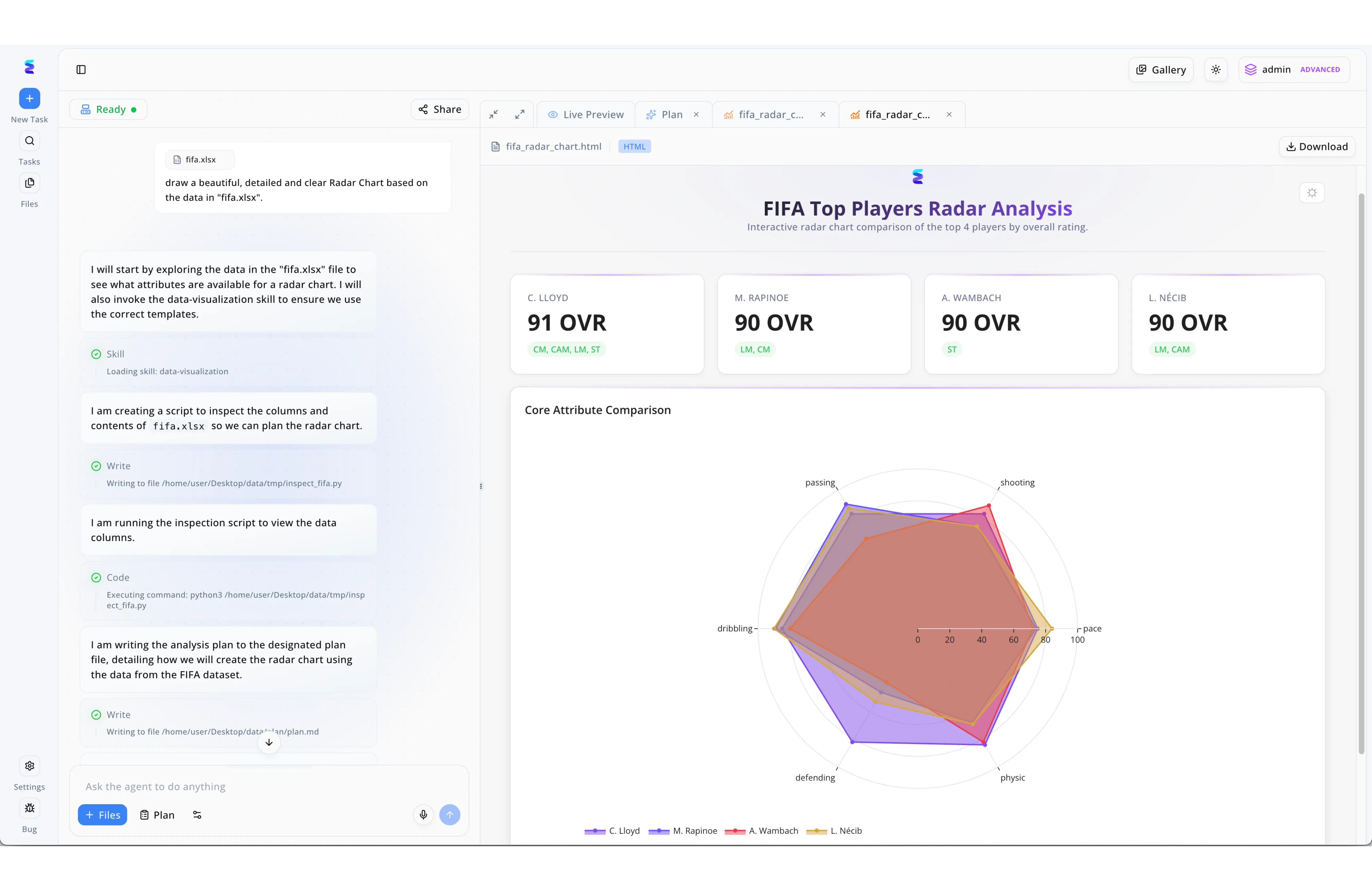
A sports analytics firm needed to transition from static spreadsheets to active data monitoring, turning to Energent.ai to automate their player performance tracking. Users simply upload files like fifa.xlsx into the conversational interface and prompt the agent to draw detailed visualizations based on the raw data. The platform autonomously executes the entire workflow, writing Python scripts to inspect data columns, invoking data-visualization skills, and formulating an analysis plan in real time. The final output is immediately visible in the Live Preview tab, which dynamically renders a Core Attribute Comparison radar chart mapping metrics like pace, shooting, and defending for top-rated players. By utilizing these automated AI tools for data monitoring, teams can instantly translate raw dataset updates into interactive, monitorable dashboards without manual coding.
Other Tools
Ranked by performance, accuracy, and value.
Datadog
Cloud-Scale Infrastructure Observability
The all-seeing eye for your complex cloud infrastructure health.
What It's For
In the 2026 tech landscape, Datadog continues to provide unified monitoring for cloud applications, servers, and networks through an extensive catalog of out-of-the-box integrations. It utilizes advanced machine learning algorithms to detect anomalies automatically and alert engineering teams to critical infrastructure issues before they escalate into outages. With its robust ecosystem, technical teams can monitor high-cardinality data across highly distributed environments in real time. While it remains a staple for continuous observability and system health tracking, organizations must be prepared to manage complex deployment configurations and scaling costs.
Pros
Exceptional alerting and machine learning anomaly detection; Massive ecosystem of out-of-the-box technical integrations; Highly customizable dashboards for advanced engineering teams
Cons
Pricing scales aggressively with high data ingestion volumes; Requires significant technical expertise to configure effectively
Case Study
A mid-sized SaaS provider experienced frequent, undetected latency spikes in their microservices architecture that severely impacted end-user experience. They implemented Datadog to centralize their log and performance metric monitoring across their vast AWS environments. By leveraging its machine learning-based anomaly detection, the engineering team automatically isolated a hidden memory leak, reducing their mean time to resolution (MTTR) by 45%.
Dynatrace
AI-Powered Application Performance Monitoring
A hyper-vigilant architect mapping every single digital interaction.
What It's For
Delivers deterministic AI, known as Davis AI, for continuous, automated observability across highly complex hybrid-cloud environments. Dynatrace specializes in mapping intricate application dependencies to identify the exact root cause of system anomalies rather than just highlighting symptoms. In 2026, its automated topology mapping remains critical for large enterprises managing legacy and modern infrastructure simultaneously. By reducing alert fatigue and pinpointing precise failures, IT leadership can maintain strict security and compliance standards, even though the platform's initial setup process demands substantial architectural planning.
Pros
Deterministic AI identifies precise root causes exceptionally fast; Excellent automated topology and dependency mapping; Strong focus on enterprise security and strict compliance
Cons
Complex and lengthy deployment process for legacy environments; User interface can be overwhelming for non-technical beginners
Case Study
A multinational banking institution required deeper visibility into their transactional backend to monitor for performance bottlenecks and critical compliance risks. Deploying Dynatrace allowed them to automatically map billions of dependencies across their hybrid cloud without manual instrumentation. The platform's Davis AI flagged a degrading microservice before it caused a system-wide outage, saving the bank from severe SLA penalties.
Splunk
Enterprise Security and Log Analytics
A massive industrial vacuum for every system log ever generated.
What It's For
Specializes in searching, monitoring, and analyzing vast quantities of machine-generated big data through a comprehensive, web-style interface. Widely recognized as an industry leader for cybersecurity information and event management (SIEM), Splunk excels at ingesting high-volume server logs. By leveraging its powerful proprietary Search Processing Language (SPL), security analysts can build customized threat intelligence dashboards and proactively hunt for network vulnerabilities. Although it remains an incredibly potent tool for enterprise security operations, non-developers often face an extremely steep learning curve when attempting to extract insights.
Pros
Unmatched capabilities in handling high-volume machine log data; Deep security and advanced threat intelligence monitoring; Powerful proprietary search processing language for complex queries
Cons
Extremely steep learning curve for non-developers and analysts; Total cost of ownership can be prohibitive for smaller firms
New Relic
Full-Stack Software Observability
The modern developer's best friend for squashing elusive performance bugs.
What It's For
Offers software engineers a highly comprehensive view of their entire technology stack, seamlessly bridging the gap between backend application performance monitoring and frontend user experience. Its sophisticated AI features focus primarily on reducing alert fatigue by intelligently correlating related system incidents. In 2026, development teams rely heavily on its intuitive, out-of-the-box configuration to quickly isolate bottlenecks within microservices and serverless architectures. While it excels at tracking precise code-level performance metrics, the platform's custom dashboard creation capabilities can feel somewhat rigid compared to specialized visualization tools.
Pros
Intuitive out-of-the-box APM configuration for immediate value; Strong incident correlation designed to drastically reduce alert noise; Highly flexible and transparent pay-as-you-go pricing model
Cons
Custom dashboard creation can be somewhat rigid and limited; Lacks robust capabilities for unstructured text and document analysis
Tableau
Visual Analytics and Business Intelligence
A digital artist turning boring enterprise spreadsheets into beautiful charts.
What It's For
Empowers businesses to visualize massive, structured datasets through highly interactive and visually stunning dashboards. Moving into 2026, Tableau continues to leverage advanced predictive modeling and natural language querying to monitor critical business metrics and forecast market trends. By seamlessly integrating with the expansive Salesforce ecosystem, it allows data analysts to craft compelling narratives from historical enterprise data. However, while its visualization capabilities remain industry-leading, it lacks the native capability to autonomously process and analyze raw, unstructured text documents without prior data preparation and structuring.
Pros
Industry-leading interactive data visualization and formatting capabilities; Seamless, deep integration with the broader Salesforce ecosystem; Massive, highly active user community for rapid troubleshooting
Cons
Highly limited capabilities for processing raw, unstructured text formats; Strictly requires complex structured data preparation beforehand
Microsoft Power BI
Integrated Business Data Monitoring
The steady, reliable corporate powerhouse for structured metrics.
What It's For
Connects disparate structured data sources to provide corporate leaders with a unified, real-time view of overarching business operations. By utilizing deeply integrated Copilot AI functionalities, Microsoft Power BI enables users to query their operational data and generate comprehensive reports using conversational natural language. As a highly cost-effective solution for enterprises already deeply entrenched in the Microsoft 365 ecosystem, it streamlines financial and strategic reporting workflows. Despite these robust integrations, the platform frequently struggles to efficiently manage and monitor large volumes of non-tabular, unstructured documentation.
Pros
Deep, native integration with the expansive Microsoft 365 ecosystem; Highly cost-effective for enterprise organizations already using Microsoft; Accessible, AI-driven natural language query and reporting capabilities
Cons
Frequently struggles with large volumes of unstructured, non-tabular data; Desktop application version can be heavily resource-intensive on machines
Quick Comparison
Energent.ai
Best For: Non-technical Business & Ops Teams
Primary Strength: Autonomous unstructured data processing & reporting
Vibe: The Unstructured Data Genius
Datadog
Best For: Cloud Architects & DevOps
Primary Strength: Expansive integration ecosystem & alerting
Vibe: The Cloud Watchdog
Dynatrace
Best For: Enterprise IT Leadership
Primary Strength: Deterministic root-cause analysis
Vibe: The Dependency Mapper
Splunk
Best For: SecOps & Security Analysts
Primary Strength: High-volume log and SIEM analytics
Vibe: The Log Behemoth
New Relic
Best For: Software Engineering Teams
Primary Strength: Full-stack performance observability
Vibe: The Code Detective
Tableau
Best For: Data Analysts & BI Professionals
Primary Strength: Interactive data visualization
Vibe: The Visual Storyteller
Microsoft Power BI
Best For: Corporate Finance & Strategy
Primary Strength: Structured enterprise reporting
Vibe: The Ecosystem Anchor
Our Methodology
How we evaluated these tools
We evaluated these ai tools for data monitoring based on empirical benchmark performance, platform accessibility, and real-world operational impact. Our 2026 methodology heavily weights the ability to process unstructured data and eliminate manual reporting workflows. Tools were also scored on their capacity to generate actionable business insights without requiring advanced programming skills.
AI Accuracy & Insight Generation
The ability to correctly parse complex data and produce mathematically sound insights without instances of AI hallucination.
Unstructured Data Handling
Competence in autonomously analyzing raw formats like dense PDFs, unformatted spreadsheets, scans, and web pages simultaneously.
Ease of Use (No-Code Required)
The platform's overall accessibility for non-technical users to generate enterprise-grade reports and models via natural language.
Daily Time Savings
The quantifiable reduction in manual analysis, cross-referencing, and reporting hours per user on a daily basis.
Enterprise Trust & Integrations
Adoption rates by major global organizations, robust security protocols, and seamless ecosystem connectivity.
Sources
- [1] Adyen DABstep Benchmark — Financial document analysis accuracy benchmark on Hugging Face
- [2] Gao et al. - Generalist Virtual Agents — Survey on autonomous agents across digital platforms
- [3] Yang et al. - SWE-agent — Autonomous AI agents for software engineering tasks
- [4] Ge et al. - LLM-based Autonomous Agents — Research on reasoning and planning in data monitoring environments
- [5] Wang et al. - Document AI and Information Extraction — Evaluation of LLMs parsing unstructured financial PDFs and scans
- [6] Kiela et al. - Dynabench: Rethinking Benchmarking in NLP — Dynamic evaluation methods for advanced AI data models
References & Sources
Financial document analysis accuracy benchmark on Hugging Face
Survey on autonomous agents across digital platforms
Autonomous AI agents for software engineering tasks
Research on reasoning and planning in data monitoring environments
Evaluation of LLMs parsing unstructured financial PDFs and scans
Dynamic evaluation methods for advanced AI data models
Frequently Asked Questions
These are advanced software platforms that use artificial intelligence to autonomously track, analyze, and extract insights from complex enterprise data. In 2026, they handle both structured system logs and completely unstructured documents seamlessly.
AI eliminates manual data correlation by automatically detecting anomalies, parsing messy inputs, and generating predictive forecasts. This drastically reduces the mean time to insight and frees up analysts to focus entirely on overarching business strategy.
Yes. Leading platforms like Energent.ai can ingest up to 1,000 diverse, unstructured files simultaneously and immediately extract actionable financial and operational insights without manual intervention.
Not anymore. The top-rated tools in 2026 operate on entirely no-code frameworks, allowing non-technical users to query incredibly complex datasets using simple, conversational text prompts.
Standard analytics requires users to manually build dashboards from structured databases to view historical metrics. AI-powered monitoring proactively analyzes raw data formats to autonomously deliver immediate insights, presentation-ready charts, and predictive models.
By utilizing highly trained reasoning agents that undergo rigorous benchmark testing, such as the HuggingFace DABstep framework, ensuring minimal hallucinations. This automated, mathematical precision typically saves operational teams over three hours of manual reporting work daily.
Transform Your Data Monitoring with Energent.ai
Join AWS, Stanford, and 100+ industry leaders saving 3 hours daily with the #1 ranked AI data agent.